
Abstract
Interpretation of follow-up prostate-specific membrane antigen positron emission tomography/computed tomography (PSMA PET/CT) during lutetium-177-labeled PSMA (177Lu-PSMA) radioligand therapy (RLT) may be misleading if rapid disease progression occurs between baseline PSMA PET/CT and initiation of RLT. A 78-year-old man with metastatic castration-resistant prostate cancer underwent baseline gallium-68-PSMA PET/CT to assess eligibility for 177Lu-PSMA-RLT and was deemed eligible. Interim PSMA PET/CT after 2 cycles showed multiple new lesions and an increased total tumor burden, suggesting progressive disease. However, these lesions were already visible on post-therapy single-photon emission computed tomography (SPECT)/CT after cycle 1, indicating interval progression between baseline PSMA PET/CT and initiation of 177Lu-PSMA-RLT rather than treatment failure. In rapidly progressive disease, cycle-1 post-therapy SPECT/CT may provide a true imaging baseline for response assessment.
Keywords: 177Lu-PSMA, PSMA PET/CT, SPECT/CT, response assessment, prostate cancer, new lesions
Ethics
Informed Consent: Informed consent was obtained from the patient for publication of this case and accompanying images.
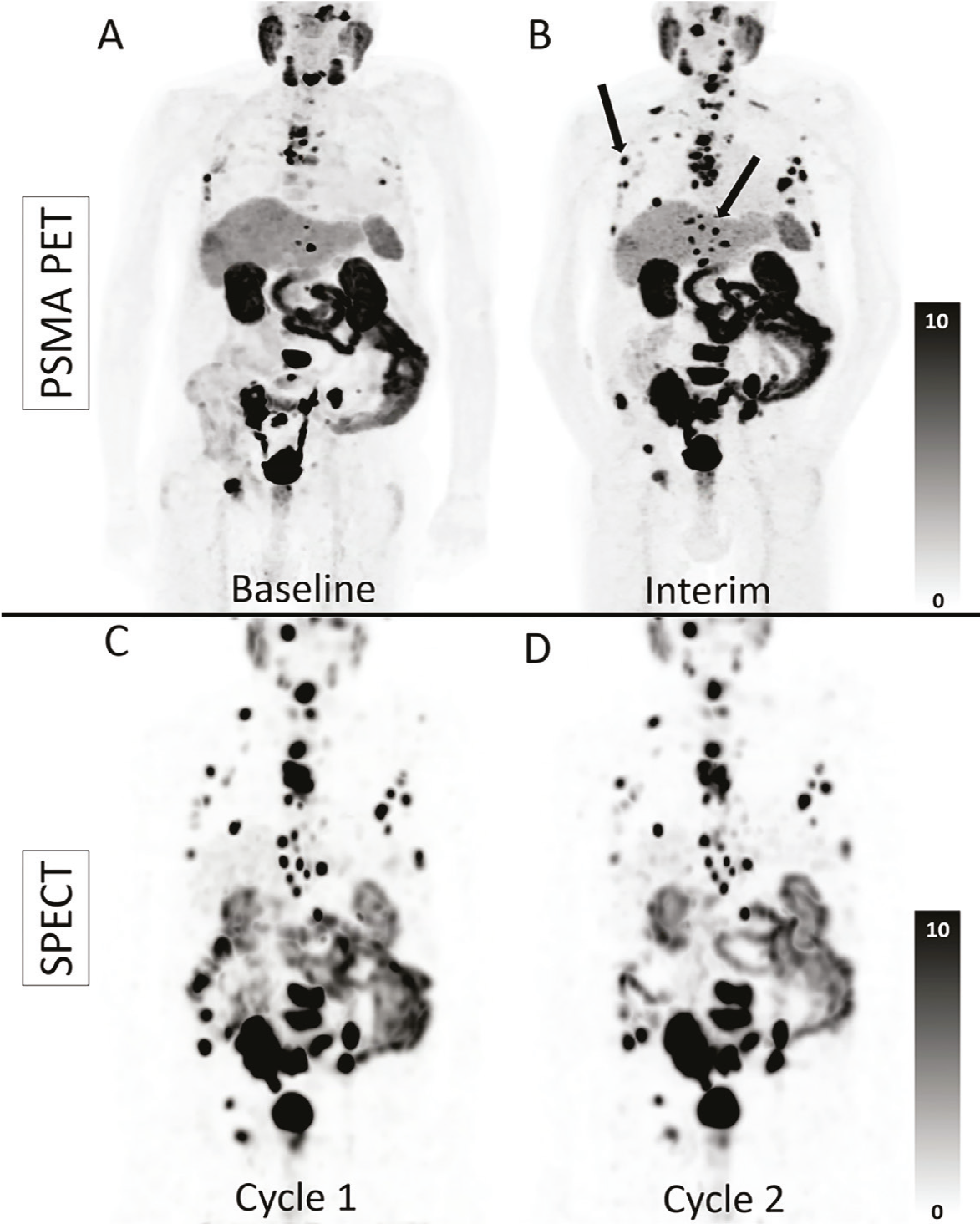
A 78-year-old man with metastatic castration-resistant prostate cancer, previously treated with abiraterone and docetaxel, was screened for lutetium-177-labeled PSMA (177Lu-PSMA) radioligand therapy (RLT) eligibility. Pre-therapy baseline gallium-68 (68Ga)-PSMA positron emission tomography/computed tomography (PET/CT) (A) showed numerous PSMA-avid skeletal metastases (mean standardized uptake value 9.2); therefore, the patient was deemed eligible for 177Lu-PSMA. He received the first cycle (7.6 GBq) 6 weeks after the baseline PSMA PET/CT, when prostate-specific antigen (PSA) had more than doubled (169 ng/mL at baseline PSMA PET/CT→351 ng/mL at cycle 1, +108%). Early interim 68Ga-PSMA PET/CT obtained after 2 cycles (cycle 2: 7.4 GBq; B) revealed multiple new vertebral and costal lesions (black arrows) with increased total tumor burden compared with pre-therapy 68Ga-PSMA PET/CT (287 mL → 732 mL, +155%), suggestive of progressive disease. However, interpretation changed when the interim PET/CT was compared side-by-side with the cycle-1 next-day post-therapy single-photon emission computed tomography (SPECT)/CT (C), which revealed at least 6 additional vertebral and costal lesions not seen on the baseline PSMA PET/CT. The apparently “new” lesions identified on interim PSMA PET/CT were already present at treatment initiation and, therefore, did not represent progression under 177Lu-PSMA-RLT. Cycle-2 next-day post-therapy SPECT/CT (D) showed a relatively stable total tumor burden without new lesions when compared with cycle 1 (786 mL → 802 mL, +2%), supporting stable disease status. 177Lu-PSMA-RLT was therefore continued. This case illustrates a pitfall in response assessment during 177Lu-PSMA-RLT: in rapidly progressive disease, when baseline PET/CT precedes treatment by several weeks, lesions that emerge before cycle 1 may be misclassified as treatment-emergent new lesions on interim PET/CT. The appearance of new lesions strongly influences PSMA-imaging response frameworks, such as Prostate Cancer Working Group 4 and RECIP 1.0 (,). In routine practice, the PSMA PET/CT used for treatment selection may precede therapy initiation by several weeks because eligibility confirmation, radiopharmaceutical ordering, scheduling, and treatment planning are time-consuming (). Importantly, the VISION trial permitted up to 6 weeks from pre-therapy PSMA PET/CT until the first cycle of 177Lu-PSMA-RLT (). As this case illustrates, such a delay may allow substantial interval disease progression before therapy initiation, potentially leading to misinterpretation of interim PSMA PET/CT. The joint European Association of Nuclear Medicine/Society of Nuclear Medicine and Molecular Imaging (SNMMI) procedure guideline does not mandate a specific interval (), whereas the SNMMI consensus statement recommends obtaining PSMA PET/CT within 3 months of treatment or since progression on the last therapy (). Repeating baseline PSMA PET/CT closer to treatment initiation would reduce this pitfall of interval progression; however, this is often limited by logistical constraints in clinical practice. A rapid PSA rise between baseline PSMA PET/CT and cycle 1 likely reflects tumor growth occurring before therapy initiation rather than progression during treatment. In such cases, cycle-1 post-therapy SPECT/CT provides a true imaging baseline, and interim PSMA PET/CT should be interpreted against both scans before classifying any new lesions as progressive disease (,).
Footnotes
Authorship Contributions
Surgical and Medical Practices: C.A., P.F., Design: C.A., Data Collection or Processing: M.K., Analysis or Interpretation: M.Z., R.P., Literature Search: R.P., Writing: M.K.
Conflict of Interest
No conflicts of interest were declared by the authors.
Financial Disclosure
The authors declare that this study has received no financial support.
References
Armstrong AJ, Morris MJ, Abida W, Aggarwal RR, Antonarakis ES, Attard G, Beltran H, Bryce A, Carducci MA, Cheng HH, Chen DL, Chi KN, Childs DS, Dahut W, Emmett L, Fizazi K, Gafita A, George DJ, Herrmann K, Hofman MS, Hope T, Hussain M, Kelly WK, Kessler E, Kuo PH, Lang J, Liu G, Marshall CH, Morgans AK, McKay RR, Nanus D, Nelson P, Paller C, Reichert ZR, Ryan CJ, Sartor AO, Schöder H, Schwartz LH, Sharifi N, Stadler WM, Stein M, Sternberg CN, Szmulewitz RZ, Tagawa ST, Sokolova AO, Wyatt AW, Yamoah K, Yu EY, Halabi S, Scher HI; PCWG4 Writing Group. Trial design and objectives for patients with prostate cancer: recommendations from the Prostate Cancer Working Group 4. J Clin Oncol. 2026;44:1249-1265.
Gafita A, Rauscher I, Weber M, Hadaschik B, Wang H, Armstrong WR, Tauber R, Grogan TR, Czernin J, Rettig MB, Herrmann K, Calais J, Weber
WA, Benz MR, Fendler WP, Eiber M. Novel framework for treatment response evaluation using PSMA PET/CT in patients with metastatic castration-resistant prostate cancer (RECIP 1.0): an international multicenter study. J Nucl Med. 2022;63:1651-1658.
Calais J, Eulau SM, Gardner L, Hauke RJ, Kendi AT, Shore ND, Zhao S. Incorporating radioligand therapy in clinical practice in the United States for patients with prostate cancer. Cancer Treat Rev. 2023;115:102524.
Sartor O, de Bono J, Chi KN, Fizazi K, Herrmann K, Rahbar K, Tagawa ST, Nordquist LT, Vaishampayan N, El-Haddad G, Park CH, Beer TM, Armour A, Pérez-Contreras WJ, DeSilvio M, Kpamegan E, Gericke G, Messmann RA, Morris MJ, Krause BJ; VISION investigators. Lutetium-177-PSMA-617 for metastatic castration-resistant prostate cancer. N Engl J Med. 2021;385:1091-1103.
Kratochwil C, Fendler WP, Eiber M, Hofman MS, Emmett L, Calais J, Osborne JR, Iravani A, Koo P, Lindenberg L, Baum RP, Bozkurt MF, Delgado Bolton RC, Ezziddin S, Forrer F, Hicks RJ, Hope TA, Kabasakal L, Konijnenberg M, Kopka K, Lassmann M, Mottaghy FM, Oyen WJG, Rahbar K, Schöder H, Virgolini I, Bodei L, Fanti S, Haberkorn U, Herrmann K. Joint EANM/SNMMI procedure guideline for the use of 177Lu-labeled PSMA-targeted radioligand-therapy (177Lu-PSMA-RLT). Eur J Nucl Med Mol Imaging. 2023;50:2830-2845.
Hope TA, Antonarakis ES, Bodei L, Calais J, Iravani A, Jacene H, Koo PJ, Morgans AK, Osborne JR, Tagawa ST, Taplin ME, Sartor O, Morris MJ. SNMMI consensus statement on patient selection and appropriate use of 177Lu-PSMA-617 radionuclide therapy. J Nucl Med. 2023;64:1417-1423.
Kassas M, Devriendt L, Manley M, Guiot T, Marin C, Danieli R, Taraji L, Kristanto P, Karfis I, Woff E, Flamen P, Artigas C. [177Lu]Lu-PSMA SPECT/CT for early response assessment using quantitative RECIP 1.0. Eur J Nucl Med Mol Imaging. 2026;53:2257-2270.
Kassas M, Jaafari A, Shagera QA, Devriendt L, Légér MA, Arçay Öztürk A, Poenaru R, Marin C, Flamen P, Artigas C. SPECT versus PET for [177Lu]Lu-PSMA response assessment using quantitative RECIP 1.0. J Nucl Med. 2026;67:903-909.