
Abstract
Post-cardiac injury syndrome (PCIS) is an autoimmune inflammatory condition that may occur weeks after cardiac surgery and can closely mimic infection on 18F-fluorodeoxyglucose positron emission tomography/computed tomography (18F-FDG PET/CT). We report the case of a 53-year-old woman who presented six weeks after aortic valve replacement and ascending aortic graft implantation, with persistent chest pain, fever, and elevated inflammatory markers, raising the suspicion of infective endocarditis. Whole-body PET demonstrated intense, heterogeneous 18F-FDG uptake along the sternotomy site and the ascending aortic graft, findings typically suggestive of infection, whereas no abnormal uptake was observed at the prosthetic valve. Despite these imaging findings, repeated blood cultures and surgical site samples remained negative. A diagnosis of Dressler syndrome, a form of PCIS, was ultimately established. Treatment with high-dose aspirin led to rapid clinical and biological improvement. This case points to a significant diagnostic pitfall in 18F-FDG PET/CT in the postoperative setting and underscores the importance of integrating imaging findings with clinical and microbiological data to avoid misdiagnosis and unnecessary antibiotic therapy.
Keywords: PCIS, endocarditis, PET/CT, Dressler
Ethics
Informed Consent: Informed consent was obtained from the patient.
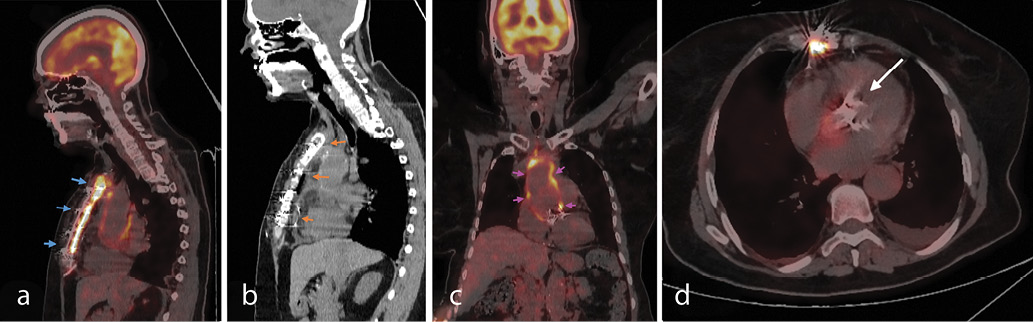
We report the case of a 53-year-old woman who underwent cardiac surgery consisting of simultaneous aortic valve replacement and ascending aortic graft implantation via median sternotomy six weeks earlier. She was referred for 18F-fluorodeoxyglucose positron emission tomography/computed tomography (18F-FDG PET/CT) because of persistent chest pain, fever, and elevated inflammatory markers. This context strongly suggested infective endocarditis. Whole-body 18F-FDG PET/CT was performed following a dedicated cardiac protocol after 24 hours of a high-fat low-carbohydrate diet, and 8 hours of strict fasting, followed by the injection of 5 MBq/kg of 18F-FDG (total activity of 340 MBq). The examination demonstrated intense 18F-FDG uptake along the sternotomy line maximum standard uptake value (SUVmax=13.1) (blue arrows on Figure 1A, representing a fusion sagittal image of the thorax), with no associated inflammatory changes or fluid collections on the CT image (orange arrows on Figure 1B, representing a CT sagittal image of the thorax). In addition, marked, heterogeneous hypermetabolism was observed along the ascending aortic graft (SUVmax=8.5; purple arrows in Figure 1C, a coronal fusion image of the thorax). Figure 1D shows low-grade left pleural effusion with no abnormal 18F-FDG uptake at the level of the prosthetic aortic valve (white arrow on the axial fusion image). Given the intensity and heterogeneity of 18F-FDG uptake, an infectious complication involving the aortic graft and sternotomy site was initially suspected. However, repeated blood cultures and local samples from the surgical site remained persistently negative. No clinical deterioration or embolic events were observed during follow-up. Ultimately, a diagnosis of Dressler syndrome (DS) was retained. DS represents a form of autoimmune-related post-cardiac injury syndrome (PCIS), characterized, in this case, by pleural effusion and persistent inflammatory activity involving the graft. The patient was treated with non-steroidal anti-inflammatory therapy at a dose of 2 g/day, resulting in rapid and marked clinical improvement. Fever resolved and inflammatory signs regressed within a few days. Follow-up confirmed complete recovery without antibiotic therapy, supporting the non-infectious inflammatory nature of the PET/CT findings. DS occurs after myocardial infarction or cardiac surgery (,). Although relatively uncommon, DS should be considered as an alternative diagnosis in patients presenting with persistent malaise, chest pain, or systemic inflammatory symptoms, particularly when symptoms occur more than two weeks after the triggering factor (). While 18F-FDG PET/CT is a powerful imaging modality for the evaluation of suspected infective endocarditis, postoperative inflammatory conditions such as DS may closely mimic infection. In the present case, PET/CT interpretation was guided by the previously published five-point semi-quantitative grading scale validated by Sah et al. () for the diagnosis of vascular graft infection. According to this scale, the marked heterogeneous 18F-FDG uptake observed in our patient corresponded to grade 4, a category considered highly suggestive of infection. Moreover, the SUVmax cut-off for infection proposed in the same study was 3.8, which is substantially lower than the values observed in our patient. In another study evaluating PET/CT findings after sternotomy in 44 patients, the mean SUVmax at five weeks post-surgery was 7.34±1.86 (). The sternotomy uptake in our patient was notably higher, suggesting that postoperative inflammatory healing processes may occasionally exceed commonly reported ranges. Differentiating infection from autoimmune-mediated inflammation remains highly challenging on 18F-FDG PET/CT, given the absence of standardized interpretation criteria in the postoperative setting. Careful integration of clinical presentation, CT morphological findings, and microbiological results is therefore essential to avoid misdiagnosis and unnecessary antibiotic treatment.
Footnotes
Authorship Contributions
Surgical and Medical Practices: A.M., I.G., H.G., Concept: A.M., Design: A.M., Data Collection or Processing: A.M., H.G., Analysis or Interpretation: A.M., I.G., H.G., Literature Search: A.M., I.G., H.G., Writing: A.M., I.G., H.G.
Conflict of Interest
No conflicts of interest were declared by the authors.
Financial Disclosure
The authors declare that this study has received no financial support.
References
Tahir MH, Sohail S, Shahid D, Hussain I, Malik J, Iqra S, Faraz M. Postcardiac injury syndrome after cardiac surgery: an evidence-based review. Cardiol Rev. 2026;34:19-23.
Jaworska-Wilczynska M, Abramczuk E, Hryniewiecki T. Postcardiac injury syndrome. Med Sci Monit. 2011;17:CQ13-CQ14.
Gungor B, Ucer E, Erdinler IC. Uncommon presentation of postcardiac injury syndrome: acute pericarditis after percutaneous coronary intervention. Int J Cardiol. 2008;128:e19-e21.
Sah BR, Husmann L, Mayer D, Scherrer A, Rancic Z, Puippe G, Weber R, Hasse B; VASGRA Cohort. Diagnostic performance of 18F-FDG-PET/CT in vascular graft infections. Eur J Vasc Endovasc Surg. 2015;49:455-464.
Blomjous MSH, Mulders TA, Wahadat AR, Tanis W, Bogers AJJC, Roos-Hesselink JW, Budde RPJ. 18F-FDG/PET-CT imaging findings after sternotomy. J Nucl Cardiol. 2023;30:1210-1218.