Impact of 18F-FDG-PET/CT in Managing a Case of Fungal Prosthetic Valve Endocarditis
PDF

Interesting Image

Impact of 18F-FDG-PET/CT in Managing a Case of Fungal Prosthetic Valve Endocarditis

Mol Imaging Radionucl Ther 2026;35(2):134-136 DOI: 10.4274/mirt.galenos.2026.43179
, , , ,
PDF
Permissions

Abstract

Approximately 0.1% of all prosthetic cardiac valves are affected by fungal endocarditis (bacterial endocarditis being the most common cause), which has a high case fatality rate. Post-treatment clinical improvement and a negative blood culture do not definitively rule out the presence of residual active disease. Among imaging techniques, trans-oesophageal echocardiography has higher sensitivity than transthoracic echocardiography, but has its own limitations. Functional imaging with 18F-fluorodeoxyglucose positron emission tomography/computed tomography (18F-FDG PET/CT) has shown to have high overall sensitivity, specificity, and accuracy for the diagnosis and follow-up evaluation of prosthetic valve infective endocarditis, thereby significantly influencing clinical management. Here, we report a rare case of a patient with Marfan syndrome and fungal prosthetic valve endocarditis, in which 18F-FDG-PET/CT played a significant role in management decision.

Keywords: Marfan syndrome, fungal endocarditis, 18F-FDG-PET/CT, prosthetic valve endocarditis, Candida endocarditis

,
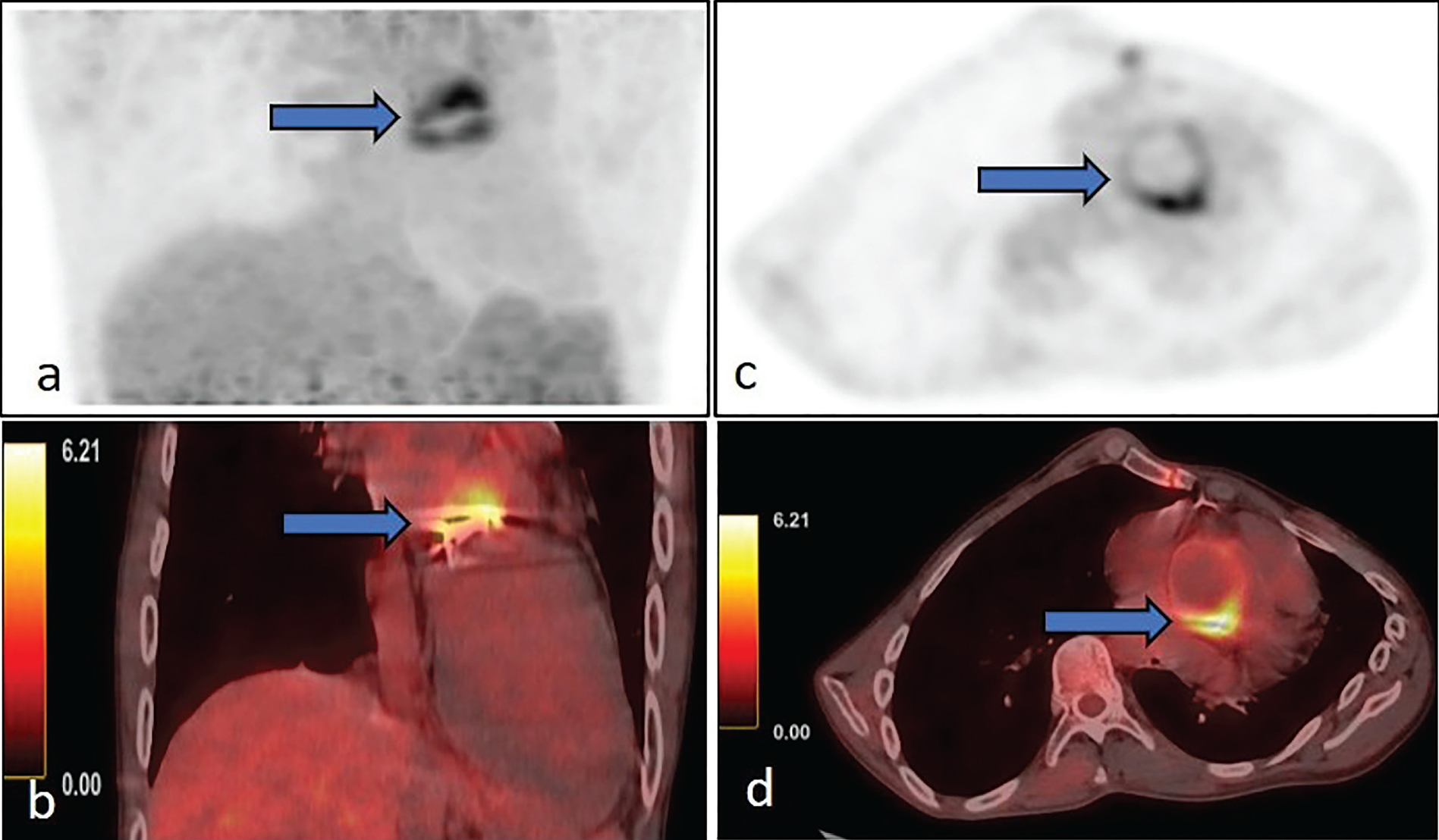
Figure 1
Figure 1. A 28 years-old-male patient with Marfan syndrome associated with severe aortic regurgitation and dilated aorta underwent aortic valve replacement surgery. One month later, he developed fungal prosthetic valve endocarditis with positive blood culture (Candida albicans and Candida parapsilosis), and 2D transthoracic echocardiography (TTE) showed multiple vegetations on the anterior mitral leaflet and the prosthetic aortic valve. After 6 weeks of treatment, repeat blood culture, 2D TTE and transesophageal echocardiography were negative for residual active disease.18F-fluorodeoxyglucose positron emission tomography/computed tomography (18F-FDG PET/CT)  (a-d) was performed to confirm any residual active focus in the heart before proceeding towards step-down approach to therapy. Cardiac non-attenuation corrected (NAC) maximum intensity projection and axial images (a,c) and corresponding fused PET/CT coronal and axial images (b,d) showed circumferential heterogeneously increased metabolic activity along the aortic prosthetic valve, suggestive of persistent residual infection. Increased metabolic activity on the NAC image ruled out a false-positive result due to overcorrection by the metallic prosthesis. Positive 18F-FDG-PET/CT led to continuation of antifungal treatment in this case. Fungal endocarditis accounts for 1% to 3% of all infective endocarditis (IE) cases, affects nearly 0.1% of all prosthetic cardiac valves, and is disproportionately associated with a high morbidity and case fatality rate (>70%); it also presents greater diagnostic challenges compared with bacterial IE (). Candida species are the most common cause of fungal endocarditis (). Blood cultures and echocardiography can be falsely negative, as in this case. 18F-FDG-PET/CT has high sensitivity and specificity of 86% and 84%, respectively for IE (). 2023 Duke-International Society for Cardiovascular Infectious Diseases Criteria for Infective Endocarditis Criteria has incorporated 18F-FDG-PET/CT in the major imaging criteria for its diagnosis owing to its high positive predictive value ().
View larger Download
Figure 2
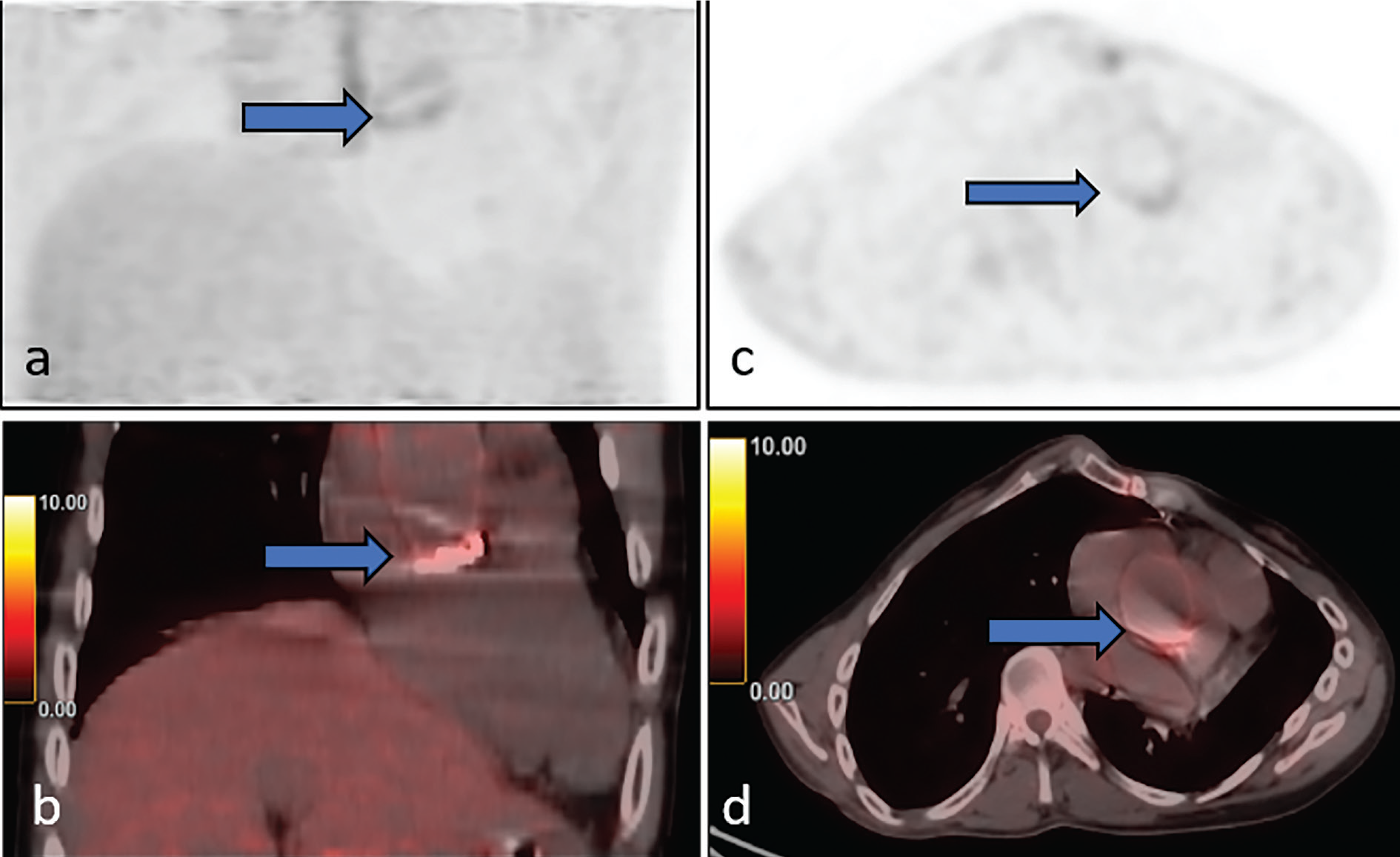
Figure 2. Corresponding follow up 18F-fluorodeoxyglucose positron emission tomography/computed tomography (18F-FDG PET/CT) images (a-d) after 8 months of treatment showed near complete resolution of the metabolic activity suggesting complete metabolic response to therapy, thus guiding treatment discontinuation. The Step-down approach to therapy is relatively common in fungal prosthetic valve endocarditis, as the infection resolves following an initial course of antifungal agents. However, long-term suppressive antifungal therapy is indicated in selected groups of patients in whom the infection persists (). This case of fungal prosthetic valve endocarditis highlights the important role and high diagnostic value of 18F-FDG-PET/CT in finding occult/residual disease in cases of negative routine diagnostic results, guiding further management and also for final response evaluation.
View larger Download

Footnotes

Ethics

Informed Consent: The participants signed a consent regarding publishing their data and photographs.

Authorship Contributions

Surgical and Medical Practices: D.S., Concept: K.B., P.S.S.P., G.K.P., K.A., D.S., Design: K.B., P.S.S.P., G.K.P., K.A., D.S., Data Collection or Processing: K.B., P.S.S.P., D.S., Analysis or Interpretation: K.B., P.S.S.P., G.K.P., K.A., D.S., Literature Search: K.B., P.S.S.P., Writing: K.B., P.S.S.P., G.K.P., K.A., D.S.

Conflict of Interest: No conflicts of interest were declared by the authors.

Financial Disclosure: The authors declare that this study has received no financial support.

References

1

Antinori S, Ferraris L, Orlando G, Tocalli L, Ricaboni D, Corbellino M, Sollima S, Galli M, Milazzo L. Fungal endocarditis observed over an 8-year period and a review of the literature. Mycopathologia. 2014;178:37-51.

2

Clancy CJ, Nguyen MH. Non-culture diagnostics for invasive candidiasis: promise and unintended consequences. Journal of Fungi. 2018;4:27.

3

Wang TKM, Sánchez-Nadales A, Igbinomwanhia E, Cremer P, Griffin B, Xu B. Diagnosis of infective endocarditis by subtype using 18f-fluorodeoxyglucose positron emission tomography/computed tomography: a contemporary meta-analysis. Circ Cardiovasc Imaging. 2020;13:e010600.

4

Fowler VG, Durack DT, Selton-Suty C, Athan E, Bayer AS, Chamis AL, Dahl A, DiBernardo L, Durante-Mangoni E, Duval X, Fortes CQ, Fosbøl E, Hannan MM, Hasse B, Hoen B, Karchmer AW, Mestres CA, Petti CA, Pizzi MN, Preston SD, Roque A, Vandenesch F, van der Meer JTM, van der Vaart TW, Miro JM. The 2023 Duke-international society for cardiovascular infectious diseases criteria for infective endocarditis: updating the modified duke criteria. Clin Infect Dis. 2023;77:518-526.

5

Arnold CJ, Johnson M, Bayer AS, Bradley S, Giannitsioti E, Miró JM, Tornos P, Tattevin P, Strahilevitz J, Spelman D, Athan E, Nacinovich F, Fortes CQ, Lamas C, Barsic B, Fernández-Hidalgo N, Muñoz P, Chu VH. Candida infective endocarditis: an observational cohort study with a focus on therapy. Antimicrob Agents Chemother. 2015;59:2365-2373.