
Abstract
Hutch diverticulum (HD) is a rare congenital condition characterized by the herniation of the bladder’s mucosa and submucosa through the detrusor muscle fibers, encountered more commonly in children. An association between HD and situs inversus totalis (SIT) in an elderly patient has not been reported previously in the literature. We present the case of a 70-year-old male referred for routine bone scintigraphy as part of staging for lung carcinoma; thoraco-abdomino-pelvic computed tomography confirmed the staging and revealed a total transposition of the thoracic and abdominal organs, confirming SIT. This case highlights the exceptional association of HD and SIT, which was discovered incidentally in an elderly patient during metastatic staging for lung cancer. It underscores the importance of careful interpretation of scintigraphic findings, particularly when unusual radiotracer uptake is observed.
Keywords: Bone scintigraphy, Hutch diverticulum, situs inversus totalis
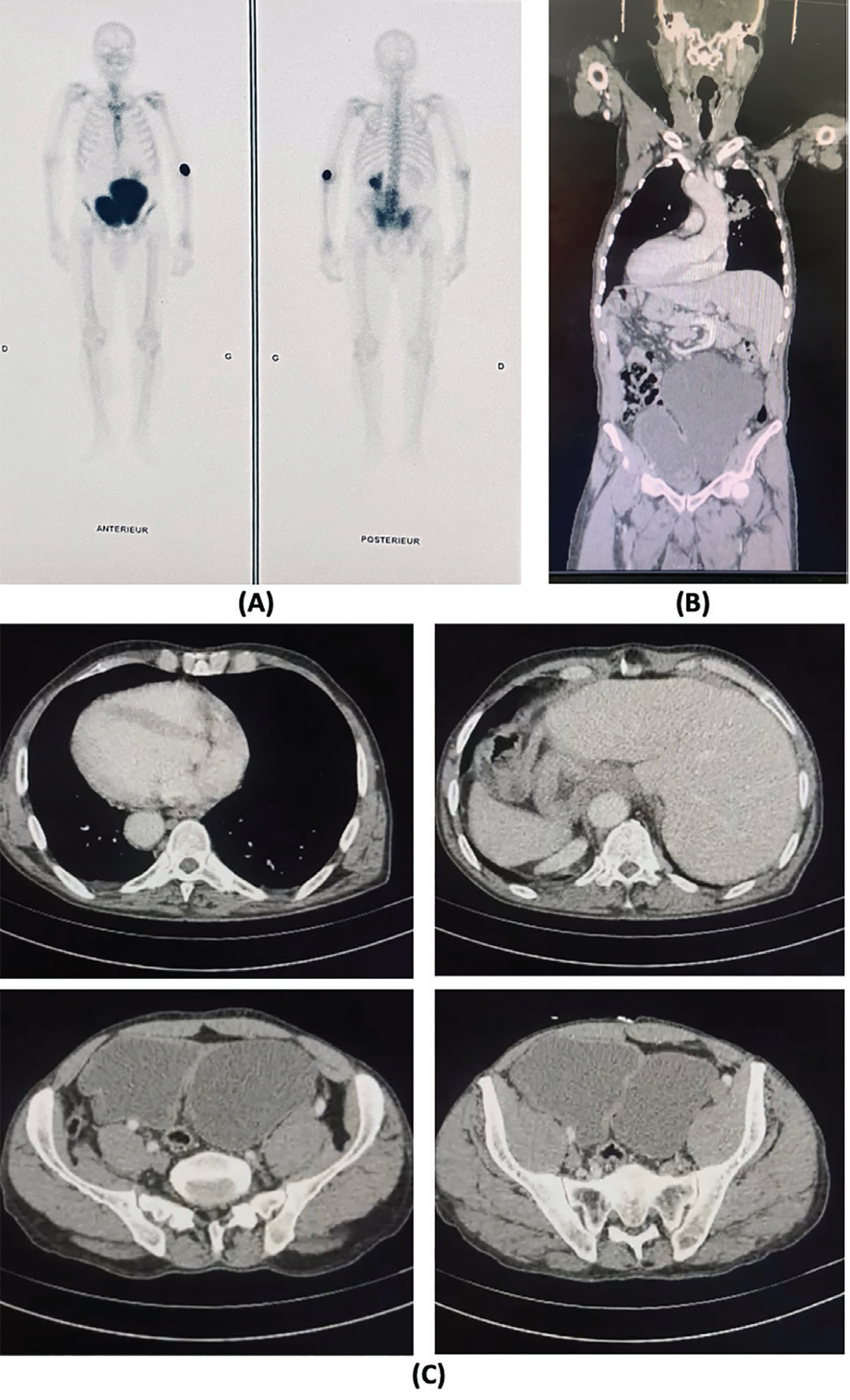
SIT is a rare congenital condition resulting from abnormal left-right axis determination during embryogenesis and associated with mutations in genes affecting ciliary function, such as DNAH5 and DNAI1. HD has been reported in association with several congenital and connective tissue disorders, including Ehlers-Danlos, Williams-Beuren, Menkes, occipital horn, and cutis laxa syndromes (). Only one pediatric case describing the association of HD and SIT has been previously reported (). To our knowledge,no case was reported in the literature about this association in adult patients. Indeed, HD occurs in children with male predominance and only 34% incidence in adult patient (); while HD and SIT are distinct entities, differential diagnoses should be considered before concluding this rare association. Bladder diverticula may arise secondary to chronic bladder outlet obstruction, neurogenic bladder dysfunction, or aquired structural abnormalities. Similarly, misinterpretation of abdominal situs in cross-sectional imaging could result from malrotation syndromes rather than true SIT (). This case suggests that particular attention should be given by the nuclear physician when interpreting scintigraphic examinations, particularly when there is an unusual uptake of the radiotracer.
Footnotes
Ethics
Informed Consent: Written informed consent was obtained from the patient for publication of this case report and accompanying images.
Authorship Contributions
Concept: L.E.A., I.G., Design: L.E.A., I.G., Data Collection or Processing: L.E.A., I.G., Analysis or Interpretation: L.E.A., H.G., A.M., I.G., Literature Search: L.E.A., I.G., Writing: L.E.A.
Conflict of Interest: No conflicts of interest were declared by the authors.
Financial Disclosure: The authors declare that this study has received no financial support.
References
Hutch JA. Saccule formation at the ureterovesical junction in smooth walled bladders. J Urol. 1961;86:390-399.
Telli O, Guclu AG, Haciyev P, Burgu B, Gogus C. A rare entity in adults: bilateral Hutch diverticulum with calculi. Can Urol Assoc J. 2015;9:E343-E344.
Palmero Martí JL, Ramirez Backhaus M, Alvarez Barrera A, Amoros Torres A, Benedicto Redon A. Hutch bladder diverticula: a very uncommon entity in adults. Arch Esp Urol. 2012;65:636-639.
Sammour ZM, Gomes CM, de Bessa J Jr, Pinheiro MS, Kim CA, Hisano M, Bruschini H, Srougi M. Congenital genitourinary abnormalities in children with Williams-Beuren syndrome. J Pediatr Urol. 2014;10:804-809.
Chen J, Liu F, Tian J, Xiang M. Laparoscopic bladder diverticulectomy in a child with situs inversus totalis: a case report and literature review. Front Surg. 2022;9:1009949.
Fulcher AS, Turner MA. Abdominal manifestations of situs anomalies in adults. Radiographics. 2002;22:1439-1456.