
Abstract
Objectives
Prostate-specific membrane antigen-positron emission tomography (PSMA-PET) has significantly improved sensitivity and specificity for detecting metastatic disease in prostate cancer compared to traditional computed tomography and bone scans. It is now recommended by the European Association of Urology for staging intermediate and high-risk disease, however, there are no recommendations on its incorporation into practice due to lack of long-term survival data. We aimed to identify the current use of PSMA-PET in high-volume prostate cancer centres to see whether there is standardisation in its use and interpretation prior to robotic-assisted laparoscopic prostatectomy (RALP).
Methods
An anonymised SurveyMonkey® was sent to multiple high-volume surgeons across the United Kingdom (UK), with all questions optional. Participants were asked about their personal practices for PSMA-PET staging, for both intermediate and high-risk disease, and how it would change their management if considering RALP.
Results
Thirty-one participants responded across 17 different UK centres. 11/31 (35%) used PSMA-PET a lone as primary staging for high-risk prostate cancer, with 6/30 (20%) using it for intermediate staging as well. Of the 23 surgeons that routinely perform lymph node dissection (LND) in high-risk cases, 13/23 (57%) would obviate performing it if the PSMA was negative. If a patient was found to have positive nodes on PSMA-PET, 12/31 (39%) surgeons will still offer RALP. Individual answers also varied within same centres.
Conclusion
The current interpretation of PSMA-PET for staging and treatment before RALP varies widely amongst surgeons, particularly regarding LND. A national consensus statement is needed to help standardise treatment practice for patients until robust long-term survival data exists.
Keywords: Prostate, PSMA, nuclear
Introduction
Accurate staging of prostate cancer is paramount to informed decision-making prior to offering radical treatment. Until 2024, European Association of Urology (EAU) recommended conventional staging for both intermediate and high-risk patients using cross-sectional abdominopelvic imaging and nuclear medicine bone scans (). However, this imaging lacks sensitivity and specificity for diagnosing extra-prostatic disease, even in high-risk cases. Prostate-specific membrane antigen positron emission tomography (PSMA-PET) as an alternative staging modality has gained popularity in recent years, due to its increased diagnostic accuracy and reduced number of equivocal findings (). In 2023, the National Comprehensive Cancer Network updated its guidelines to recommend the use of PSMA-PET as first-line imaging for primary staging of prostate cancer (, ). In 2024, EAU endorsed its use, where available, for primary staging of both intermediate and high-risk disease (). However, solely based on PSMA-PET, they could not offer a clear recommendation on its interpretation and on the application regarding radical treatment, including robotic-assisted laparoscopic prostatectomy (RALP), due to a lack of long-term randomized control trial (RCT) survival data.
Amidst the prevailing uncertainty we aimed to identify the utilization and interpretation of PSMA-PET prior to RALP amongst different United Kingdom (UK), centres and whether this was broadly similar or lacked standardisation. We designed and distributed a bespoke online survey regarding the use of PSMA-PET in primary prostate cancer staging to various high-volume pelvic oncology surgeons working across in the UK.
Materials and Methods
A bespoke and anonymised SurveyMonkey® was distributed to high-volume prostate cancer surgeons across the UK in October 2023. Participants were asked nine questions () about their hospital practices for PSMA-PET staging, in both intermediate and high-risk disease, how it would change their management if considering RALP. All questions were optional and collated anonymously.
Table 1. Nine questions asked to high-volume RALP surgeons in the UK
- | Question | Options |
|---|---|---|
Question 1 | Which hospital do you work in? | - |
Question 2 | Approximately how many RALPs does your hospital perform each year? | a) 0-49 b) 50-99 c) 100-149 d) 150-199 e) 200+ |
Question 3 | How do you currently stage high-risk prostate cancer in your hospital? | a) CT and bone scan b) Bone scan only c) PSMA-PET only |
Question 4 | How do you currently stage intermediate-risk Gleason 4+3 prostate cancer in your hospital? | a) CT and bone scan b) Bone scan only c) PSMA-PET only |
Question 5 | Does a negative PSMA-PET change your decision to do a lymph node dissection in an otherwise high risk patient? | a) Yes - It obviates the need to perform it b) No - I would still perform it if deemed necessary c) I do not routinely perform lymph node dissection |
Question 6 | Would you still perform radical prostatectomy in patients with positive nodes on PSMA-PET, and otherwise favourable factors? | a) Yes - With lymph node dissection b) Yes - Without lymph node dissection c) Rarely |
Question 7 | If yes, do you use PSMA-PET images to help guide lymph node dissection? | a) Yes b) No |
Question 8 | Do you routinely use the Briganti nomogram to predict likelihood of lymph node involvement? | a) Yes b) No |
Question 9 | For high risk patients, with a solitary positive node in the field of pelvic nodal extirpation, would you consider a trial in which RALP is performed and SABR offered to the node in a multimodal setting? | a) Yes b) No |
PSMA-PET: Prostate-specific membrane antigen-positron emission tomography, CT: Computed tomography, RALP: Robotic-assisted laparoscopic prostatectomy
Statistical Analysis
Statistical analysis was not required for data interpretation.
Results
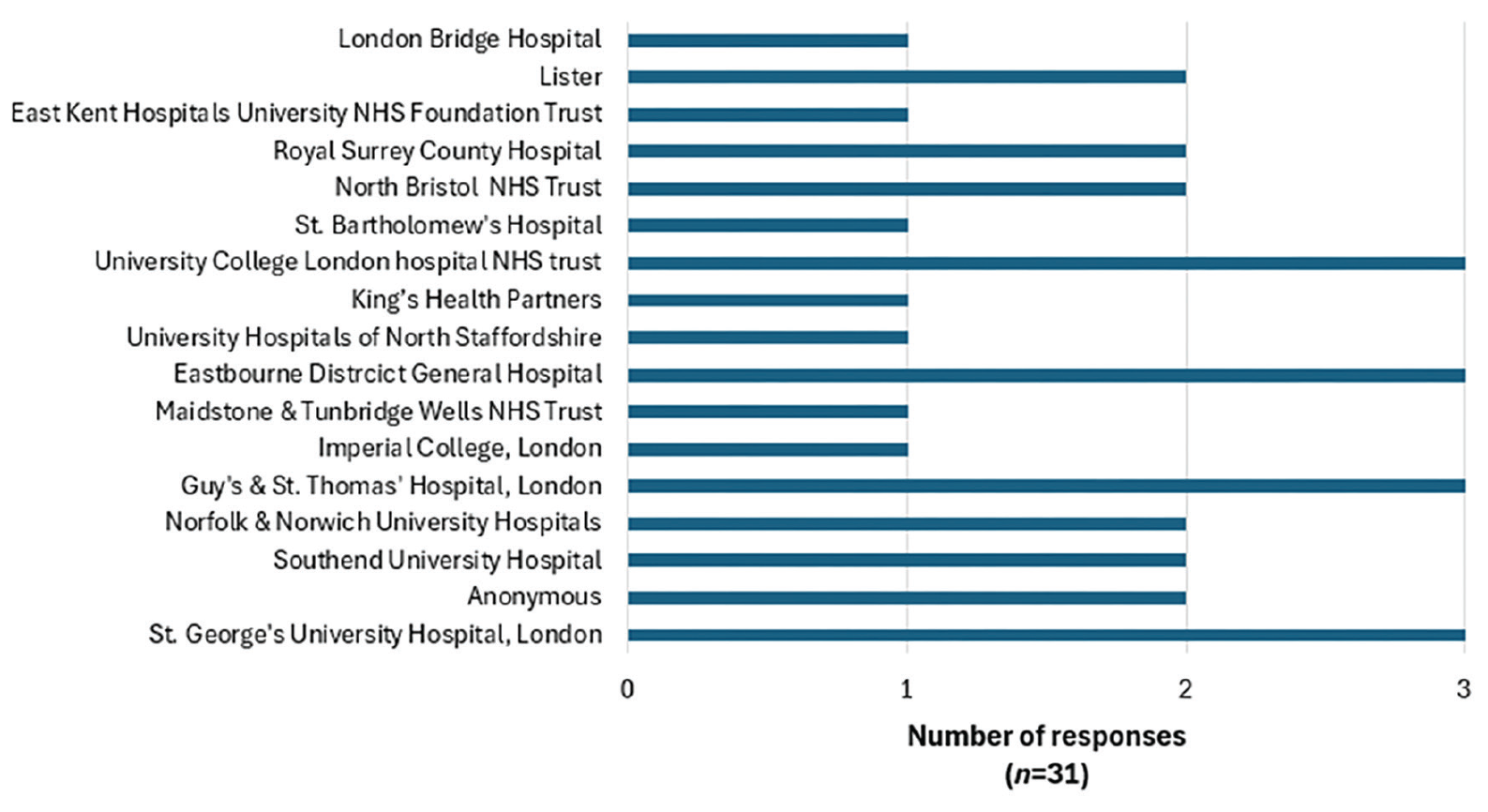
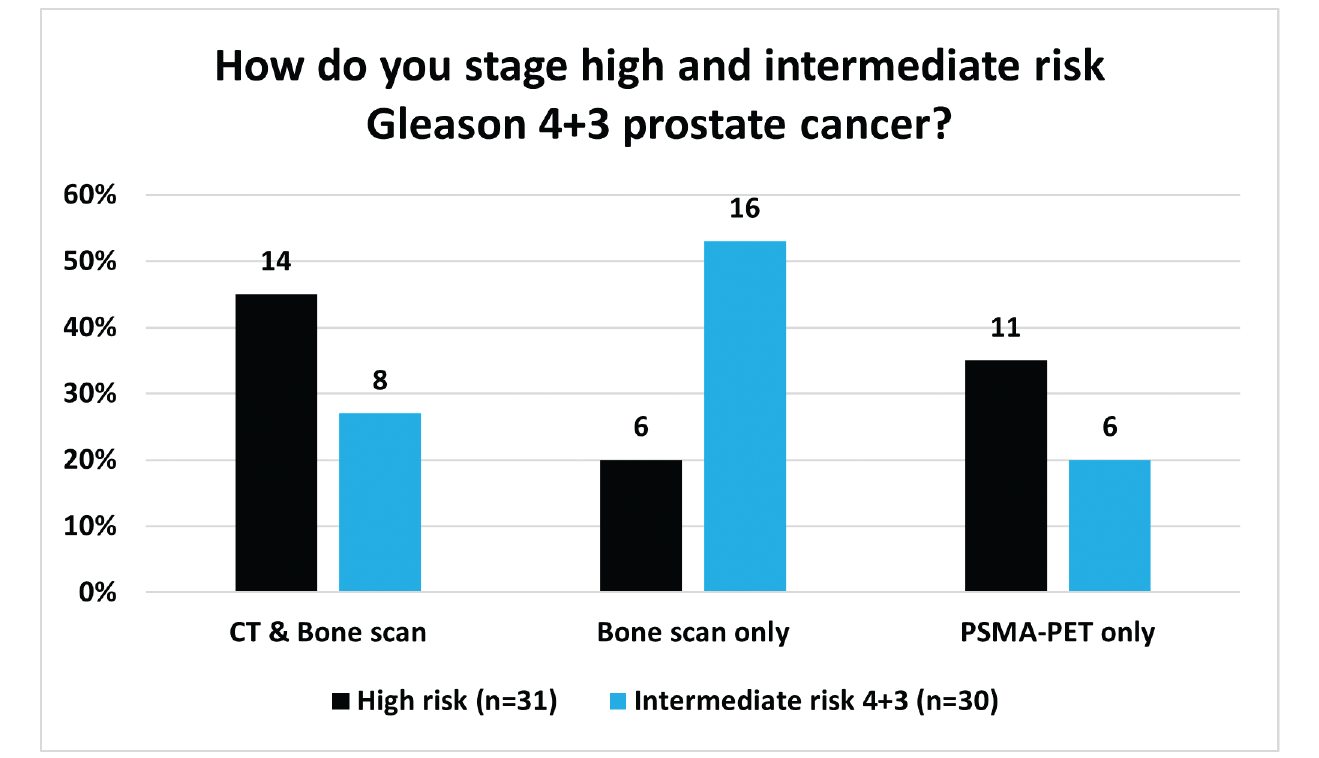
Thirty-one participants responded across 17 different UK centres (). 18/31 (58%) worked in centres annually performing over 200 RALPs; 30/31 (97%) performed at least 50. There was large heterogeneity in the use of PSMA-PET for staging: 11/31 (35%) used PSMA-PET alone as primary staging for high-risk prostate cancer, with 6/30 (20%) using it for intermediate staging as well. For those who used conventional staging rather than PSMA-PET, 14/31 (45%) used computed tomography (CT) and bone scans for high-risk staging, with 6/31 (19%) used only bone scans. In intermediate imaging, 16/30 (53%) used bone scans only, while 8/30 (26%) used both CT and bone scans ().
PSMA-PET: Prostate-specific membrane antigen-positron emission tomography, RALP: Robotic-assisted laparoscopic prostatectomy, CT: Computed tomography
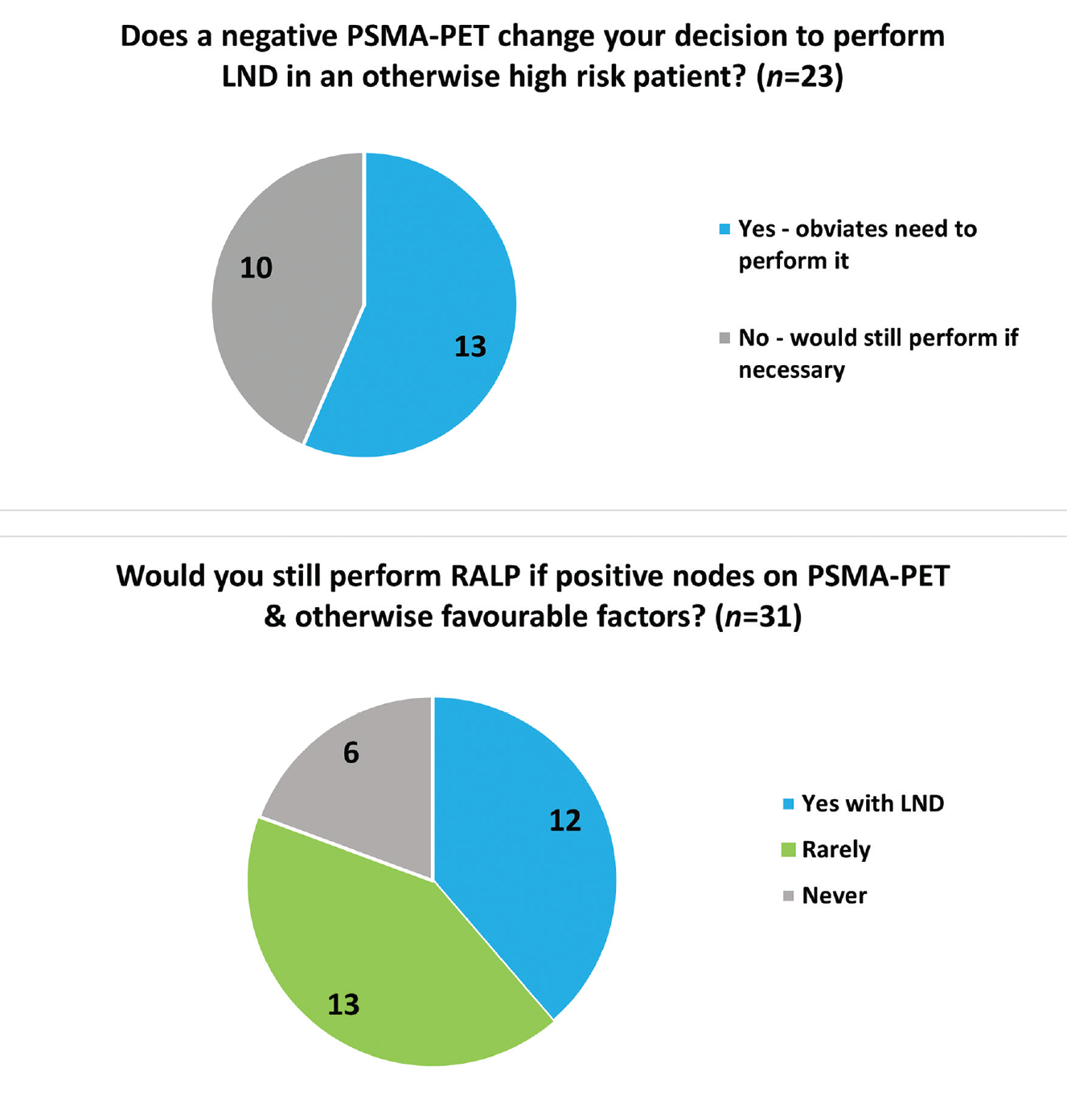
Of the 23 surgeons that routinely perform lymph node dissection (LND) in high-risk cases, 13/23 (57%) would obviate performing it if the PSMA was negative. If a patient was found to have positive nodes on PSMA-PET, 12/31 (39%) surgeons would still offer radical prostatectomy as a treatment option and 12/29 (41%) would use the PSMA-PET images to guide their LND (). Individual answers also varied within same centres. 14/31 (45%) routinely use the Briganti nomogram to predict lymph node involvement, and 24/31 (77%) would support the trial with RALP and subsequent SABR for a single positive node in the field of pelvic node extirpation.
PSMA-PET: Prostate-specific membrane antigen-positron emission tomography, RALP: Robotic-assisted laparoscopic prostatectomy, LND: Lymph node dissection
Discussion
The role of PSMA-PET is an evolving one: only in 2024 have the EAU finally recommended the use of PSMA-PET in staging of intermediate and high-risk prostate cancer. However, they fall short of a recommendation regarding treatment due to a lack of long-term survival data from RCTs (). This leaves clinicians in a conundrum: staging with PSMA-PET is now recommended, but the interpretation and application of PSMA-PET prior to treatment remain unclear. It is therefore unsurprising to see the large heterogeneity in our survey on the use of PSMA-PET prior to RALP. This reflects both the diagnostic uncertainty of PSMA-PET in its ability to exclude metastatic disease and the potential survival benefit of radical treatment based on PSMA-PET rather than conventional staging. This subsequently impacts several clinical decisions for surgeons prior to RALP, in particular, the clinical utility of performing LND. EAU advise that LND in high-risk patients may be useful for staging, although systematic reviews have shown they are not associated with improved oncological outcomes (). Given its lack of therapeutic benefit and significant associated morbidity, many clinicians are reluctant to perform the procedure. Interestingly, approximately half of respondents felt confident they could avoid LND if they usually performed it, as long as the PSMA-PET was negative. In addition, 12/31 (39%) respondents were still happy to offer RALP with LND if a patient had positive nodal disease detected on PSMA-PET, a response which also does not suggest consensus. Previous studies have suggested that PSMA-PET could be used to guide LND (), and several respondents perform the procedure, despite no recommendation. Whilst there is no long-term data to support biochemical recurrence-free survival or overall survival benefit, there is a possibility targeted LND, using PSMA-PET, may change this.
Study Limitations
It is worth noting, our survey was conducted in October 2023, prior to the EAU recommending PSMA-PET for staging. It is therefore likely heterogeneity with PSMA-PET staging may have improved as its nationwide availability improved. At the time of writing, no recommendations on the interpretation of PSMA-PET prior to RALP are available, and our results are therefore likely to be representative. Historically, PET has been a unique modality; its utilization is dictated more by “availability” than by the pace at which “favourable evidence” can be collated. This realization amplifies the need for consensus among practitioners.
Conclusion
The lack of recommendations regarding interpretation of PSMA-PET in primary staging of prostate cancer has resulted in large heterogeneity in practice when offering radical prostatectomy. National consensus, achieved through expert opinion, is needed to standardise care for patients and ensure similar practice across the UK until robust long-term data assessing its role in prostate cancer exist.
Footnotes
Ethics
Ethics Committee Approval: Not required.
Informed Consent: This article was an anonymous survey of surgeons, not patients. Because there are no patients included in the paper, patient consents and ethical approval were not required.
Authorship Contributions
Surgical and Medical Practices: R.N.K., P.K.S., H.B., S.S.K., Concept: R.N.K., P.K.S., H.B., S.S.K., Design: R.N.K., P.K.S., H.B., S.S.K., Data Collection or Processing: R.N.K., P.K.S., H.B., S.S.K., Analysis or Interpretation: R.N.K., P.K.S., H.B., S.S.K., Literature Search: R.N.K., P.K.S., H.B., S.S.K., Writing: R.N.K., P.K.S., H.B., S.S.K.
Conflict of Interest: No conflict of interest was declared by the authors.
Financial Disclosure: The authors declared that this study has received no financial support.
References
EAU Guidelines - Uroweb [Internet]. Available from: https://uroweb.org/guidelines
Hofman MS, Lawrentschuk N, Francis RJ, Tang C, Vela I, Thomas P, Rutherford N, Martin JM, Frydenberg M, Shakher R, Wong LM, Taubman K, Ting Lee S, Hsiao E, Roach P, Nottage M, Kirkwood I, Hayne D, Link E, Marusic P, Matera A, Herschtal A, Iravani A, Hicks RJ, Williams S, Murphy DG; proPSMA Study Group Collaborators. Prostate-specific membrane antigen PET-CT in patients with high-risk prostate cancer before curative-intent surgery or radiotherapy (proPSMA): a prospective, randomised, multicentre study. Lancet. 2020;395:1208-1216.
Jochumsen MR, Bouchelouche K. PSMA PET/CT for primary staging of prostate cancer - an updated overview. Semin Nucl Med. 2024;54:39-45.
Schaeffer EM, Srinivas S, Adra N, An Y, Barocas D, Bitting R, Bryce A, Chapin B, Cheng HH, D’Amico AV, Desai N, Dorff T, Eastham JA, Farrington TA, Gao X, Gupta S, Guzzo T, Ippolito JE, Kuettel MR, Lang JM, Lotan T, McKay RR, Morgan T, Netto G, Pow-Sang JM, Reiter R, Roach M, Robin T, Rosenfeld S, Shabsigh A, Spratt D, Teply BA, Tward J, Valicenti R, Wong JK, Berardi RA, Shead DA, Freedman-Cass DA. NCCN guidelines ® insights: prostate cancer, version 1.2023. J Natl Compr Canc Netw. 2022;20:1288-1298.
Fossati N, Willemse PM, Van den Broeck T, van den Bergh RCN, Yuan CY, Briers E, Bellmunt J, Bolla M, Cornford P, De Santis M, MacPepple E, Henry AM, Mason MD, Matveev VB, van der Poel HG, van der Kwast TH, Rouvière O, Schoots IG, Wiegel T, Lam TB, Mottet N, Joniau S. The benefits and harms of different extents of lymph node dissection during radical prostatectomy for prostate cancer: a systematic review. Eur Urol. 2017;72:84-109.
Maurer T, Robu S, Schottelius M, Schwamborn K, Rauscher I, van den Berg NS, van Leeuwen FWB, Haller B, Horn T, Heck MM, Gschwend JE, Schwaiger M, Wester HJ, Eiber M. 99m Technetium-based prostate-specific membrane antigen-radioguided surgery in recurrent prostate cancer. Eur Urol. 2019;75:659-666.