
Abstract
A 74-year-old man with a history of prostate cancer and rising prostate-specific antigen underwent 18F-prostate specific membrane antigen (PSMA)-1007 positron emission tomography/computed tomography for investigation of oligometastatic disease. There was evidence of PSMA avid local recurrence findings with pelvic and retroperitoneal nodal metastases and skeletal deposits. Although rare and could easily be mistaken for contamination, a small penile metastasis was found. This is associated with poor prognosis and could impact further management. This case highlights the importance of a detailed review of the penis, to ensure differentiation between urinary activity and pathological uptake.
Keywords: 18F-PSMA-1007 positron emission tomography/computed tomography, prostate cancer, penile metastasis
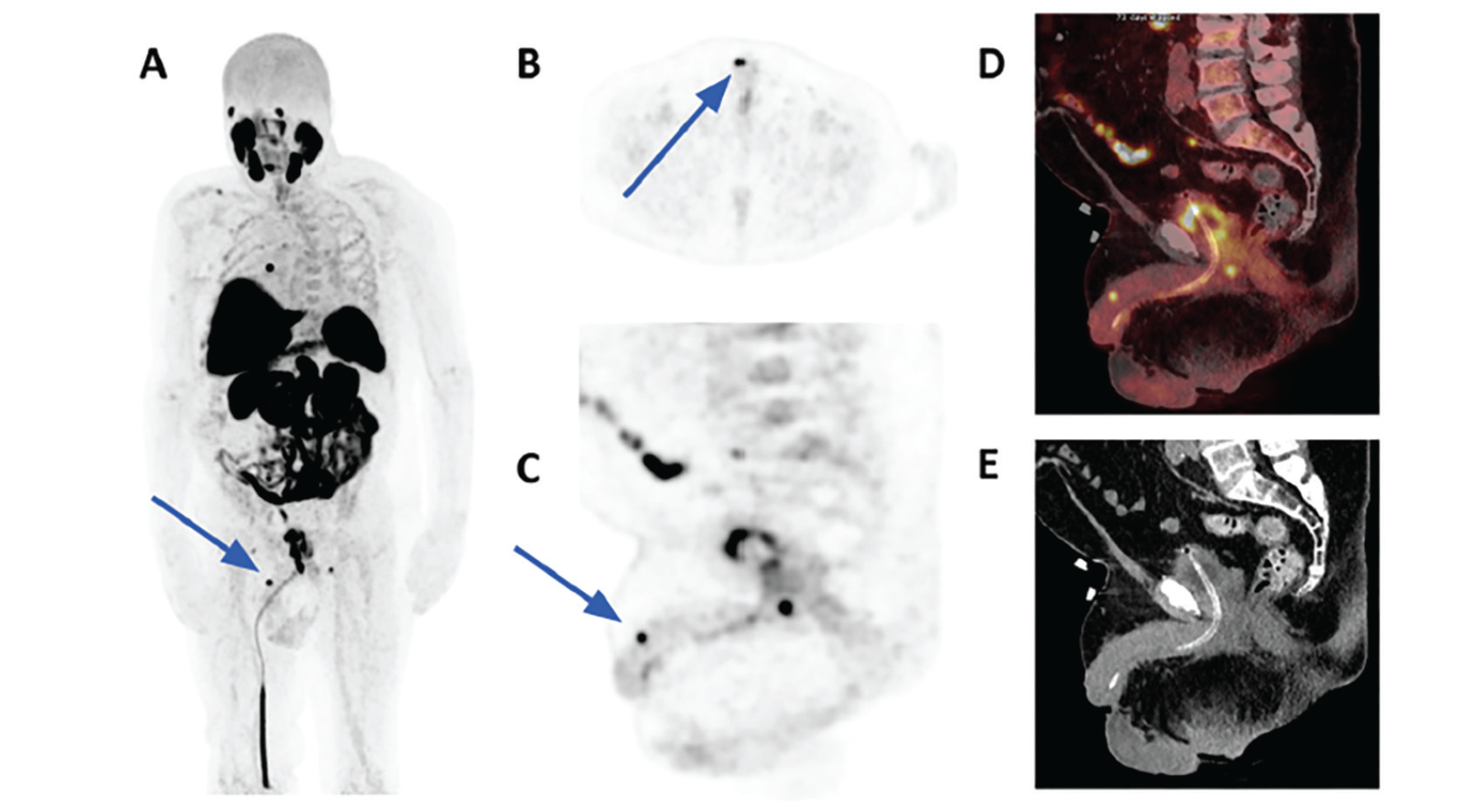
To our knowledge, there has been one case report of a penile metastasis from prostate cancer detected on 18F-PSMA PET, this was a case of a solitary penile metastasis found on baseline staging in a patient with prostate cancer and PSA>90 ng/mL (). Our case describes an unexpected example of a 18F-PSMA avid penile deposit, as part of multifocal recurrence of prostate cancer in a patient with suspected recurrence due to rising PSA. This is associated with extremely poor prognosis, with an average survival of 9 months ().
Footnotes
Ethics
Informed Consent: The patient has given permission for anonymised imaging and clinical information to be used for teaching, audit, research and publications including social media.
Authorship Contributions
Surgical and Medical Practices: A.N., J.S, I.L, Concept: A.N., J.S, I.L, Design: H.K, A.N., J.S, I.L, Data Collection or Processing: H.K, A.N., J.S, I.L, Analysis or Interpretation: H.K, A.N., J.S, I.L, Literature Search: H.K., Writing: H.K, A.N., J.S, I.L.
Conflict of Interest: No conflicts of interest were declared by the authors.
Financial Disclosure: The authors declare that this study has received no financial support.
References
Ferrari M, Treglia G. 18 F-PSMA-1007 PET in biochemical recurrent prostate cancer: an updated meta-analysis. Contrast Media Mol Imaging. 2021;2021:3502389.
Cornford P, van den Bergh RCN, Briers E, Van den Broeck T, Cumberbatch MG, De Santis M, Fanti S, Fossati N, Gandaglia G, Gillessen S, Grivas N, Grummet J, Henry AM, der Kwast THV, Lam TB, Lardas M, Liew M, Mason MD, Moris L, Oprea-Lager DE, der Poel HGV, Rouvière O, Schoots IG, Tilki D, Wiegel T, Willemse PM, Mottet N. EAU-EANM-ESTRO-ESUR-SIOG guidelines on prostate cancer. Part II-2020 update: treatment of relapsing and metastatic prostate cancer. Eur Urol. 2021;79:263-282.
Morawitz J, Kirchner J, Lakes J, Bruckmann NM, Mamlins E, Hiester A, Aissa J, Loberg C, Schimmöller L, Arsov C, Antke C, Albers P, Antoch G, Sawicki LM. PSMA PET/CT vs. CT alone in newly diagnosed biochemical recurrence of prostate cancer after radical prostatectomy: comparison of detection rates and therapeutic implications. Eur J Radiol. 2021;136:109556.
Zhang K, Da J, Yao HJ, Zheng DC, Cai ZK, Jiang YQ, Xu MX, Wang Z. Metastatic tumors of the penis: a report of 8 cases and review of the literature. Medicine (Baltimore). 2015;94:e132.
Dai Y, Shi BL, Zhang J, Liu SN, Jia YT. Penile metastasis from prostate cancer misdiagnosed as Peyronie disease: a case report. Sex Med. 2023;11:qfac011.
Kamaleshwaran KK, Balasundararaj BKP, Jose R, Shinto AS. Penile metastasis from prostate cancer presenting as malignant priapism detected using Gallium-68 prostate-specific membrane antigen positron emission tomography/computed tomography. Indian J Nucl Med. 2018;33:57-58.
Hodolič M, Fettich J, Cimitan M, Kragelj B, Goldsmith SJ. Unusual F-18 choline uptake in penile metastasis from prostate cancer. Clin Nucl Med. 2012;37:e89-e90.
Bianchi D, Rizzo A, Bonacina M, Zaniboni A, Savelli G. penile metastasis from prostate cancer detected by 18f-fluorocholine PET/CT. Clin Nucl Med. 2021;46:e38-e39.
Dhull VS, Kshirsagar P, Chowhan M, Patil SC. Solitary penile metastasis from prostate cancer on 18 f-prostate-specific membrane antigen positron emission tomography/computed tomography. Indian J Nucl Med. 2022;37:402-403.
Rohan V, Hanji A, Patel J, Goswami J, Tankshali R. Penile metastases from prostate cancer. Urol J. 2009;6:217-219.