
Abstract
Gout is an inflammatory arthropathy that develops due to the accumulation of monosodium urate crystals in the joints in adults. In approximately half of the cases, it presents as monoarthritis with an acute attack involving the first metatarsophalangeal joint. The first attack is rarely polyarticular. Herein, we present a male patient who presented with swelling and acute pain in the 5th toe but 18F-fluorodeoxyglucose positron emission tomography/computed tomography showed symmetric polyarticular involvement which was mimicking arthritis.
Keywords: Gout disease, 18F-FDG PET/CT, arthritis
,
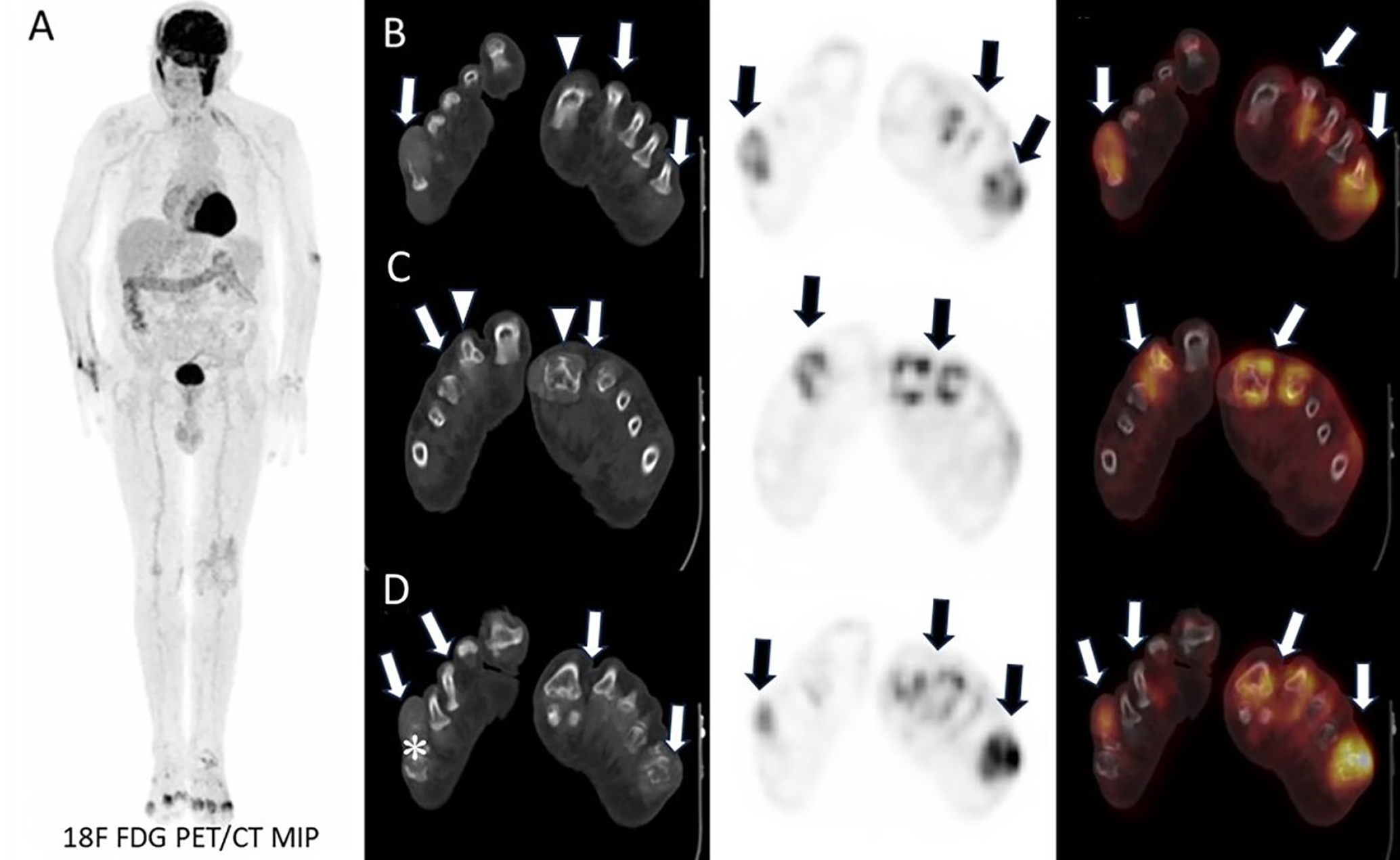
18F-FDG PET/CT: 18F-fluorodeoxyglucose positron emission tomography/computed tomography, MIP: Maximum intensity projection
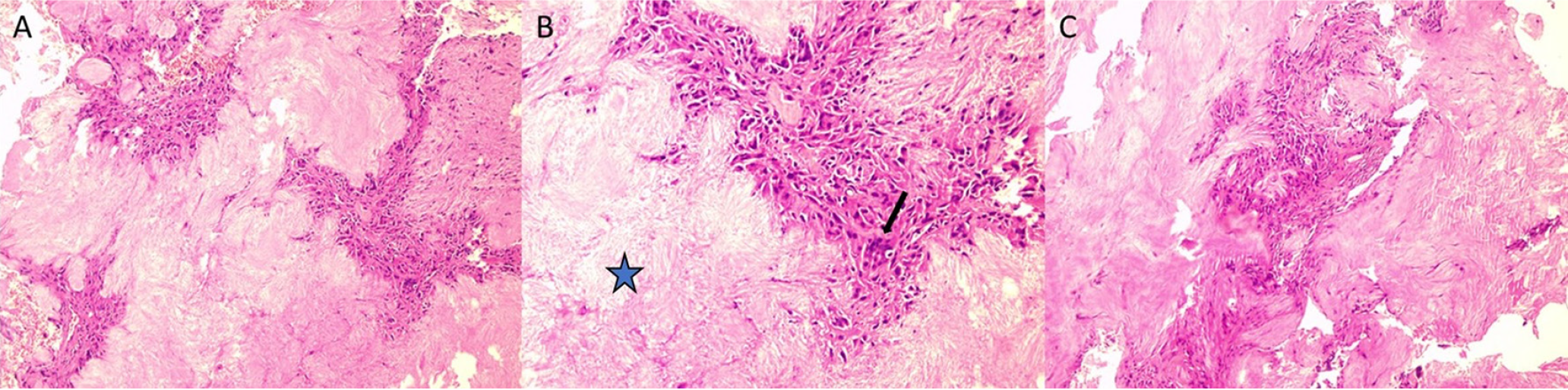
18F-fluorodeoxyglucose (18F-FDG) is not specific to cancer. Increased 18F-FDG uptake can be detected in cells involved in inflammation due to increased glucose metabolism (). Therefore, 18F-FDG is an ideal biological marker for evaluating arthritic disorders (). In gout arthritis, moderate 18F-FDG uptake can be observed in tophi, adjacent joints, and soft tissues (,). 18F-FDG uptake is generally lower than that seen in malignant lesions (). Polyarticular involvement of gout disease is unusual. It can mimic other rheumatological arthritis or more rarely metastatic disease on 18F-FDG positron emission tomography/computed tomography (PET/CT) (,). Arthritic symptoms can also be caused by paraneoplastic events, such as carcinoma polyarthritis (). However, periarticular localization observed on CT, along with juxta-articular erosive lesions that have sclerotic and protruding borders, suggests gout (,). In elderly men who undergo 18F-FDG PET/CT imaging to rule out malignancy, as in our case, focal 18F-FDG uptake due to gouty arthropathy should be considered. There are limited data in the literature showing the benefits of functional imaging in gouty arthropathy. Excluding malignancy and early detection of the disease with 18F-FDG PET/CT can lead to earlier treatment and improved patient outcomes.
Footnotes
Ethics
Informed Consent: The written and verbal informed consent was obtained from the patient.
Authorship Contributions
Surgical and Medical Practices: Z.N.T., E.A., Concept: A.N.T.Y., E.A., E.A., Design: G.A., E.A., Data Collection or Processing: Z.N.T., E.A., Analysis or Interpretation: A.N.T.Y., E.A., G.A., Literature Search: Z.N.T., G.A., E.A., Writing: E.A.
Conflict of Interest: No conflicts of interest were declared by the authors.
Financial Disclosure: The authors declare that this study has received no financial support.
References
Kwee TC, de Klerk JMH, Nix M, Heggelman BGF, Dubois SV, Adams HJA. Benign bone conditions that may be FDG-avid and mimic malignancy. Semin Nucl Med. 2017;47:322-351.
Carey K, Saboury B, Basu S, Brothers A, Ogdie A, Werner T, Torigian DA, Alavi A. Evolving role of FDG PET imaging in assessing joint disorders: a systematic review. Eur J Nucl Med Mol Imaging. 2011;38:1939-1955.
Davies J, Riede P, van Langevelde K, Teh J. Recent developments in advanced imaging in gout. Ther Adv Musculoskelet Dis. 2019;11:1759720X19844429.
Parathithasan N, Lee WK, Pianta M, Oon S, Perera W. Gouty arthropathy: review of clinico-pathologic and imaging features. J Med Imaging Radiat Oncol. 2016;60:9-20.
Jamar F, van der Laken CJ, Panagiotidis E, Steinz MM, van der Geest KSM, Graham RNJ, Gheysens O. Update on imaging of ınflammatory arthritis and related disorders. Semin Nucl Med. 2023;53:287-300.
Rybak LD, Rosenthal DI. Radiological imaging for the diagnosis of bone metastases. Q J Nucl Med. 2001;45:53-64.
Ito K, Minamimoto R, Morooka M, Kubota K. A case of gouty arthritis to tophi on 18F-FDG PET/CT imaging. Clin Nucl Med. 2012;37:614-617.
Weaver JS, Vina ER, Munk PL, Klauser AS, Elifritz JM, Taljanovic MS. Gouty arthropathy: review of clinical manifestations and treatment, with emphasis on ımaging. J Clin Med. 2021;11:166.