
Abstract
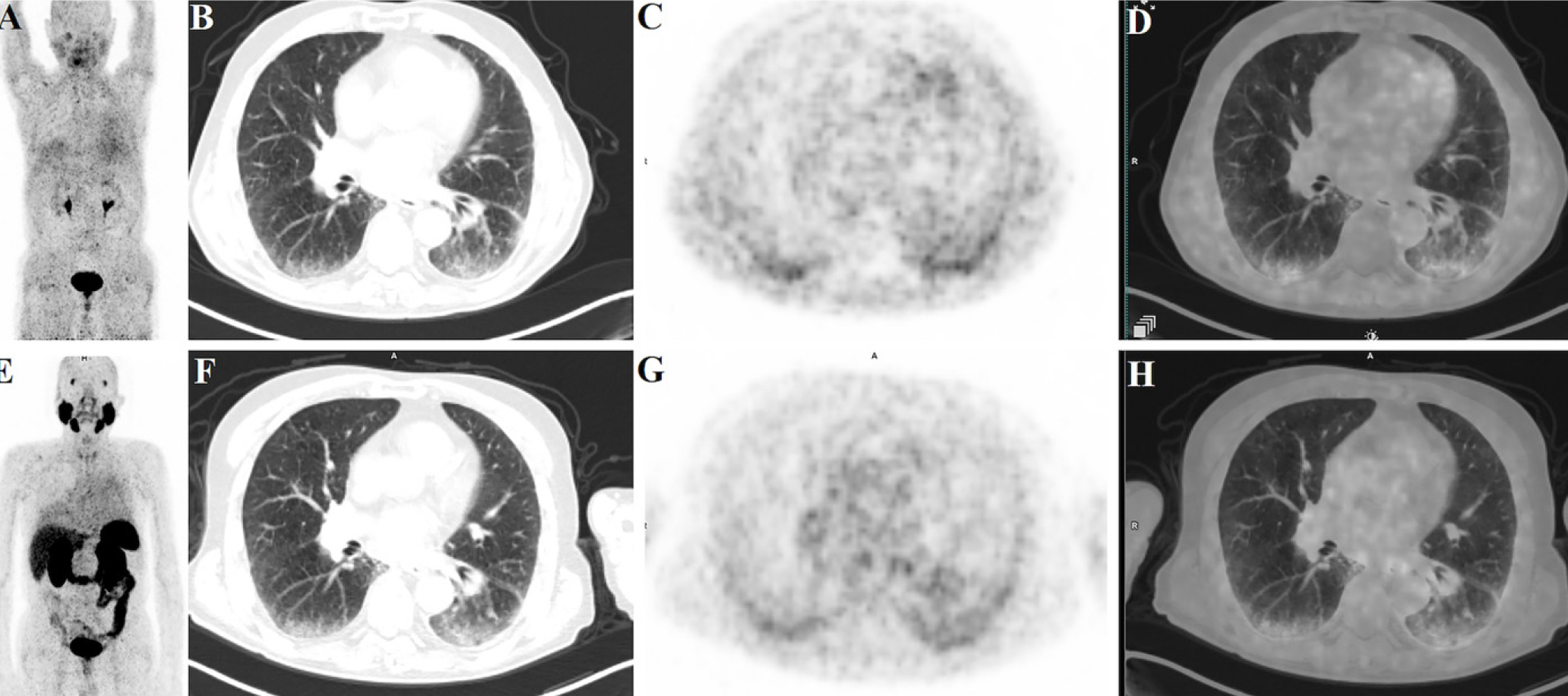
We present the 68Ga-prostate-specific membrane antigen (PSMA) and 68Ga-fibroblast activation protein inhibitor (FAPI)-04 positron emission tomography/computed tomography (PET/CT) findings comparatively of a 76-year-old man with a history of progressive dyspnea and evidence of interstitial lung disease (ILD) abnormalities on high-resolution CT. Moderate PSMA uptake was observed in areas with ILD abnormalities on 68Ga-PSMA PET/CT. 68Ga-FAPI-04 PET/CT showed relatively higher FAPI-04 uptake in these regions. These findings offer the potential to assess disease activity at the cellular and molecular levels. This approach may provide valuable insight into the pathophysiology of ILD beyond the structural changes captured by traditional imaging methods.
Keywords: Fibroblast activation protein inhibitor, interstitial lung disease, PSMA, PET
Footnotes
Ethics
Informed Consent: The patient provided written informed consent.
Authorship Contributions
Surgical and Medical Practices: H.Ö., A.K., Concept: H.Ö., A.K., Design: H.Ö., A.K., Data Collection or Processing: H.Ö., A.K., Analysis or Interpretation: H.Ö., A.K., Literature Search: H.Ö., A.K., Writing: H.Ö., A.K.
Conflict of Interest: No conflicts of interest were declared by the authors.
Financial Disclosure: The authors declare that this study has received no financial support.
References
Mendes RG, Castello-Simões V, Trimer R, Garcia-Araújo AS, Gonçalves Da Silva AL, Dixit S, Di Lorenzo VAP, Archiza B, Borghi-Silva A. Exercise-Based Pulmonary Rehabilitation for Interstitial Lung Diseases: A Review of Components, Prescription, Efficacy, and Safety. Front Rehabil Sci. 2021;2:744102.
Rodriguez K, Ashby CL, Varela VR, Sharma A. High-Resolution Computed Tomography of Fibrotic Interstitial Lung Disease. Semin Respir Crit Care Med. 2022;43:764-779.
de Galiza Barbosa F, Queiroz MA, Nunes RF, Costa LB, Zaniboni EC, Marin JFG, Cerri GG, Buchpiguel CA. Nonprostatic diseases on PSMA PET imaging: a spectrum of benign and malignant findings. Cancer Imaging. 2020;20:23.
Rosenkrans ZT, Massey CF, Bernau K, Ferreira CA, Jeffery JJ, Schulte JJ, Moore M, Valla F, Batterton JM, Drake CR, McMillan AB, Sandbo N, Pirasteh A, Hernandez R. [(68) Ga]Ga-FAPI-46 PET for non-invasive detection of pulmonary fibrosis disease activity. Eur J Nucl Med Mol Imaging. 2022;49:3705-3716.
Dendl K, Koerber SA, Kratochwil C, Cardinale J, Finck R, Dabir M, Novruzov E, Watabe T, Kramer V, Choyke PL, Haberkorn U, Giesel FL. FAP and FAPI-PET/CT in Malignant and Non-Malignant Diseases: A Perfect Symbiosis? Cancers (Basel). 2021;13:4946.
Yang P, Luo Q, Wang X, Fang Q, Fu Z, Li J, Lai Y, Chen X, Xu X, Peng X, Hu K, Nie X, Liu S, Zhang J, Li J, Shen C, Gu Y, Liu J, Chen J, Zhong N, Su J. Comprehensive Analysis of Fibroblast Activation Protein Expression in Interstitial Lung Diseases. Am J Respir Crit Care Med. 2023;207:160-172.
Sviridenko A, di Santo G, Virgolini I. Imaging Fibrosis. PET Clin. 2023;18:381-388.
Mori Y, Kramer V, Novruzov E, Mamlins E, Röhrich M, Fernández R, Amaral H, Soza-Ried C, Monje B, Sabbagh E, Florenzano M, Giesel FL, Undurraga Á. Initial results with [(18)F]FAPI-74 PET/CT in idiopathic pulmonary fibrosis. Eur J Nucl Med Mol Imaging. 2024;51:1605-1611.
Röhrich M, Leitz D, Glatting FM, Wefers AK, Weinheimer O, Flechsig P, Kahn N, Mall MA, Giesel FL, Kratochwil C, Huber PE, Deimling AV, Heußel CP, Kauczor HU, Kreuter M, Haberkorn U. Fibroblast Activation Protein-Specific PET/CT Imaging in Fibrotic Interstitial Lung Diseases and Lung Cancer: A Translational Exploratory Study. J Nucl Med. 2022;63:127-133.