
Pseudoprogression Shown on 18F-FDG PET/CT After Pembrolizumab Treatment in a Case of Metastatic Bladder Cancer
PDF

Interesting Image

Pseudoprogression Shown on 18F-FDG PET/CT After Pembrolizumab Treatment in a Case of Metastatic Bladder Cancer

Mol Imaging Radionucl Ther 2025;34(1):70-72 DOI: 10.4274/mirt.galenos.2024.47135
, , , ,
PDF
Permissions

Abstract

A 57-year-old man diagnosed with a metastatic bladder tumor was initiated on pembrolizumab treatment. 18F-fluorodeoxyglucose (18F-FDG) positron emission tomography/computed tomography (PET/CT) imaging performed to evaluate treatment response showed numerical-dimensional and metabolic increase in the metastatic lesions. In the 18F-FDG PET/CT imaging performed 8 weeks later due to suspicion of pseudoprogression, a significant regression of the lesions was observed, and the patient was diagnosed with pseudoprogression. Pseudoprogression should be kept in mind when 18F-FDG PET/CT is performed after the use of immunotherapy, and evaluation with follow-up PET/CT is recommended to confirm that the patient has hyperprogression or pseudoprogression.

Keywords: Immunotherapy, pseudoprogression, bladder cancer, pembrolizumab, PET/CT
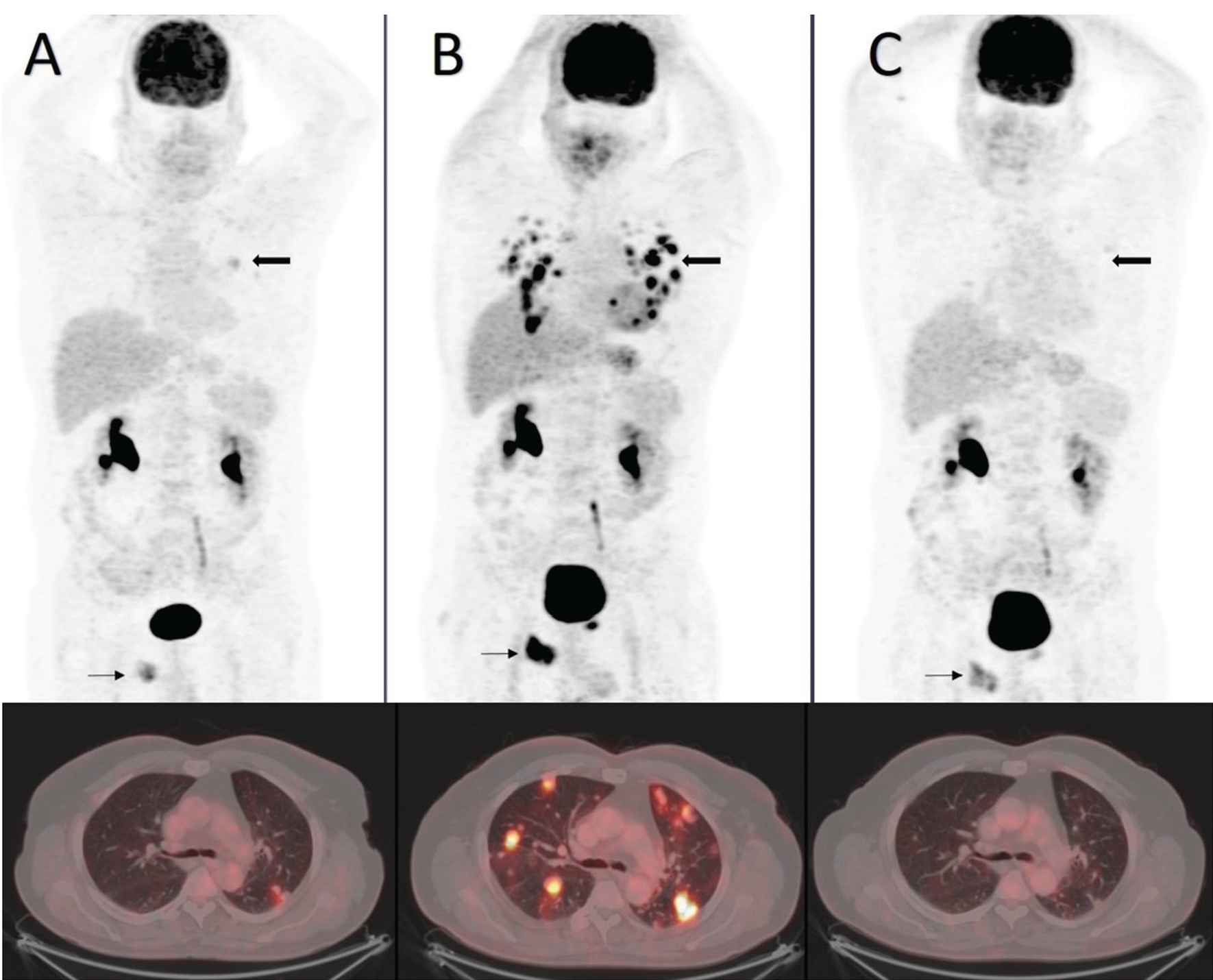
Figure 1
Figure 1. A 57-year-old man with high-grade papillary urothelial carcinoma who underwent transurethral resection of the bladder received gemstabin, cisplatin, and zolendronic acid due to lung and bone metastases in the initial staging. 18Flourine-fluorodeoxyglucose (18F-FDG) positron emission tomography/computed tomography (PET/CT) imaging [A: maximum intensity projection (MIP) and axial fusion] performed to evaluate treatment response showed increased 18F-FDG uptake in multiple nodular lesions (thick arrows) [maximum standardized uptake value (SUVmax): 4.4], the largest of which was 11x8 mm in both lungs and lytic lesion (thin arrow) (SUVmax: 8.2) in the right ischium. Because there was a numerical progression in lung metastases compared with the previous PET/CT imaging (not shown), pembrolizumab treatment was initiated as second-line treatment. After 4 cycles of pembrolizumab treatment (after 3 months), PET/CT imaging (B: MIP and axial fusion) showed markedly increased intense 18F-FDG uptake in multiple nodular lesions (thick arrows) (SUVmax: 15.4), the largest of which was 23x23 mm in both lungs and lytic-sclerotic lesions (thin arrow) (SUVmax: 15.6) in the left pubic-right ischial bones. In the multidisciplinary oncology council, the patient was considered pseudoprogression, and pembrolizumab treatment was continued. PET/CT imaging 8 weeks later (C: MIP and axial fusion) showed significant numerical and metabolic regression of nodular lesions (thick arrows) in both lungs, the largest of which regressed to 11x11 mm in size, and low 18F-FDG uptake was observed in the nodules (SUVmax: 2.2). Reduced 18F-FDG uptake was observed in the right ischial and left pubic bones (thin arrow) (SUVmax: 7) compared with the previous study. The patient was diagnosed with pseudoprogression, and treatment was continued. Immune checkpoint inhibitors have a wide range of indications, and their frequency of use is increasing (1). Overexpression of programed cell death protein-1 (PD-1)/programed cell death ligand 1 (PD-L1) in muscle‐invasive bladder cancer (MIBC) tissue was found to be associated with high 18F-FDG uptake in the tumor (2). A recent study prospectively investigated the value of 18F-FDG PET/CT for predicting lymph node metastasis (LNM) in MIBC patients receiving neoadjuvant pembrolizumab. PET/CT results were compared with histopathological findings, and the sensitivity to detect LNM was found to be 27% and 37.5%, and the specificities were 97% and 98% for 18F-FDG PET/CT before and after pembrolizumab, respectively (3). Pseudoprogression describes the phenomenon of marked disease progression (increase in size and 18F-FDG-affinity of lesions) on 18F-FDG PET scan within 12 weeks of the start of immunotherapy, with a reduction in tumor burden if immunotherapy is continued (4). The incidence of pseudoprogression in urothelial cancer ranges from 1.5% to 17% (5). A new category of unconfirmed progression (iUPD) has been created in the immune-based therapeutics Response Evaluation Criteria in Solid Tumors and requires confirmation of progression (increase in size or number of lesions) on follow-up imaging. This treatment is usually recommended after 4-8 weeks following an initial study showing significant disease progression (6). The role of pseudoprogression on 18F-FDG PET/CT in patients with MIBC treated with immunotherapy requires further investigation.
View larger Download

Footnotes

Ethics

Informed Consent: Informed consent was obtained from the patient.

Authorship Contributions

Concept: H.K., C.G., Design: H.K., C.G., İ.H.D., Data Collection or Processing: F.K., V.Ş., İ.H.D., Literature Search: F.K., C.G., V.Ş., Writing: F.K., C.G.

Conflict of Interest: No conflicts of interest were declared by the authors.

Financial Disclosure: The authors declare that this study has received no financial support.

References

1

Vaddepally RK, Kharel P, Pandey R, Garje R, Chandra AB. Review of Indications of FDA-approved immune checkpoint inhibitors per NCCN Guidelines with the level of evidence. Cancers (Basel). 2020;20:12(3):738.

2

Chen R, Zhou X, Liu J, Huang G. Relationship between the expression of PD-1/PD-L1 and 18F-FDG uptake in bladder cancer. Eur J Nucl Med Mol Imaging. 2019;46(4):848-854.

3

Marandino L, Capozza A, Bandini M, Raggi D, Farè E, Pederzoli F, Gallina A, Capitanio U, Bianchi M, Gandaglia G, Fossati N, Colecchia M, Giannatempo P, Serafini G, Padovano B, Salonia A, Briganti A, Montorsi F, Alessi A, Necchi A. [18F]Fluoro-Deoxy-Glucose positron emission tomography to evaluate lymph node involvement in patients with muscle-invasive bladder cancer receiving neoadjuvant pembrolizumab. Urol Oncol. 2021;39(4):235.e15-235.e21.

4

Jia W, Gao Q, Han A, Zhu H, Yu J. The potential mechanism, recognition and clinical significance of tumor pseudoprogression after immunotherapy. Cancer Biol Med. 2019;16(4):655-670.

5

Soria F, Beleni AI, D’Andrea D, Resch I, Gust KM, Gontero P, Shariat SF. Pseudoprogression and hyperprogression during immune checkpoint inhibitor therapy for urothelial and kidney cancer. World J Urol. 2018;36(11):1703-1709.

6

Gandy N, Arshad MA, Wallitt KL, Dubash S, Khan S, Barwick TD. Immunotherapy-related adverse effects on 18F-FDG PET/CT imaging. Br J Radiol. 2020;93(1111):20190832.