
Abstract
A Chemoport is frequently utilized in oncological patients for administering chemotherapy. However, inadequate care can lead to various infectious and non-infectious complications. Infection commonly presents as a local infection that can lead to life-threatening septicemia. Early diagnosis and intervention are necessary to reduce morbidity and mortality. We report a patient with breast cancer who underwent 18F-fluorodeoxyglucose positron (18F-FDG) positron emission tomography/computed tomography (PET/CT) due to suspicion of metastatic disease. 18F-FDG-PET/CT revealed pyomyositis involving multiple skeletal muscles and septic emboli in the lungs and identified the chemoport as a possible source of infection. The infection source was confirmed and the patient responded to anti-microbiological therapy.
Keywords: Chemoport-related infection, breast cancer, 18F-FDG PET/CT, pyomyositis, methicillin-resistant staphylococcus aureus
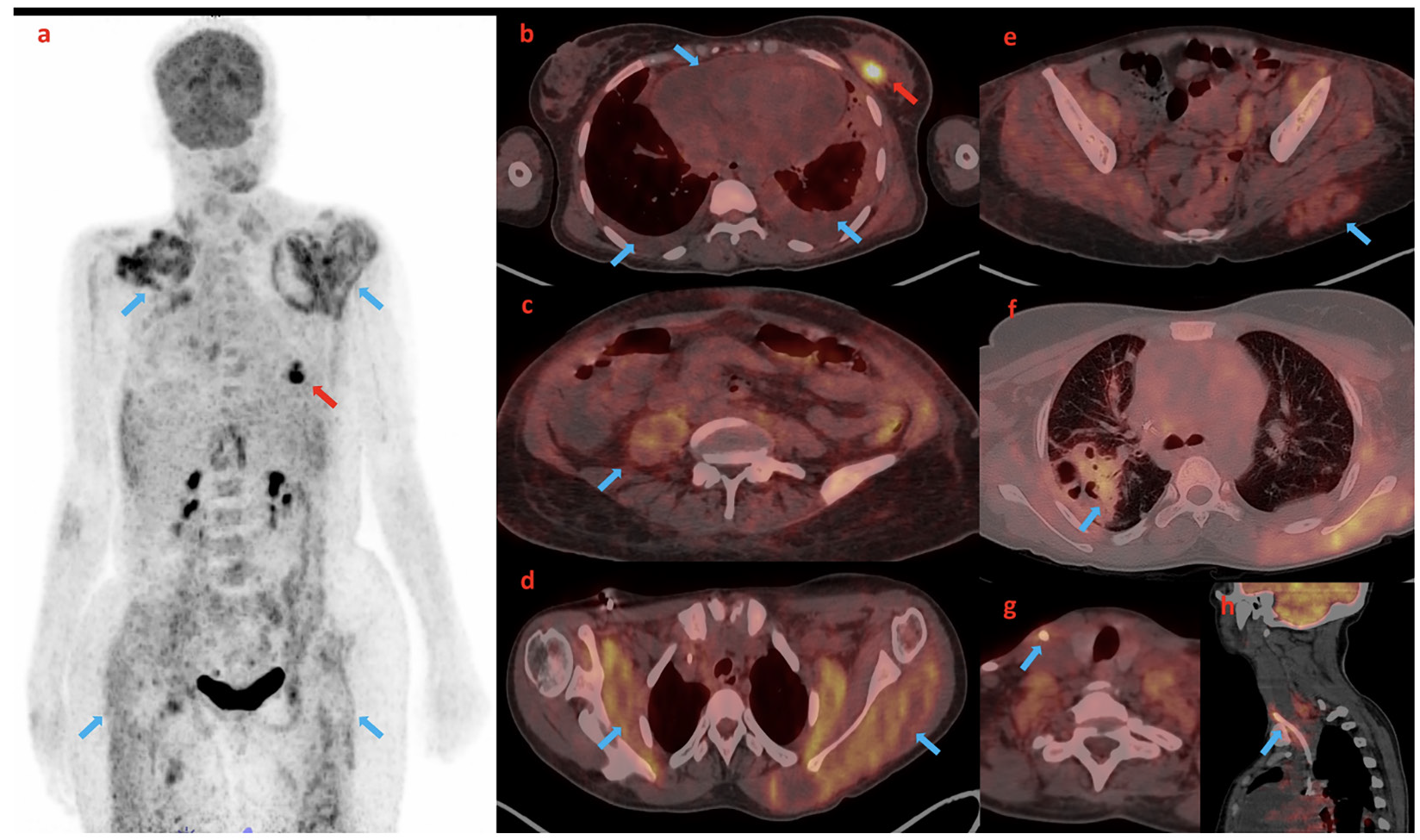
An implantable chemoport device is used to administer chemotherapies with the aim of reducing the need for frequent venipunctures. Common complications include thrombosis, catheter obstruction, extravasation, catheter migration, and catheter fracture infection (1,2,3,4). These conditions may be associated with significant morbidity and mortality. The incidence of central venous access port-related infection ranges from 0.21 to 0.66 per 1000 catheter days (3,5). Hematogenous seeding may cause endocarditis, suppurative thrombosis, osteomyelitis, and metastatic site infections (4). Staphylococcus, Gram-negative bacilli, and Candida are the predominant pathogens (4,5). Although rare, extensive pyomyositis can also occur (6). General treatment principles involve blood and catheter cultures, initiating empirical intravenous antimicrobial therapy, device removal if clinically indicated, and tailoring the antimicrobial spectrum based on culture results (4).
Footnotes
Ethics
Informed Consent: Informed consent was obtained.
Authorship Contributions
Concept: V.S., M.O., Design: V.S., D.S., N.K., M.O., S.G., Data Collection or Processing: V.S., D.S., N.K., M.O., S.G., Analysis or Interpretation: V.S., D.S., N.K., M.O., S.G., Literature Search: V.S., M.O., Writing: V.S., M.O.
Conflict of Interest: No conflicts of interest were declared by the authors.
Financial Disclosure: The authors declare that this study has received no financial support.
References
Machat S, Eisenhuber E, Pfarl G, Lenz K, Payer F, Duran C, Längle F, Reiner CS, Ketteler H, Betz M. Complications of central venous port systems: a pictorial review. Insights Imaging. 2019;10:86.
Mittal GS, Sundriyal D, Naik NB, Bansal D, Khandelwal N, Singh K, Rathi A, Gupta A, Kapoor R. Totally implantable venous access device (Chemoport) in oncology: study of 168 polyurethane Chemoport catheter system. South Asian J Cancer. 2021;10:261-4.
Aparna S, Ramesh S, Appaji L, Ghosh P, Chatterjee N, Manohar S. Complications of Chemoport in children with cancer: Experience of 54,100 catheter days from a tertiary cancer center of Southern India. South Asian J Cancer. 2015;4:143-5.
Sousa B, Furlanetto J, Hutka M, Baggott S, Bassam T, Chiappino C, Mavri V. ESMO Guidelines committee. Central venous access in oncology: ESMO clinical practice guidelines. Ann Oncol. 2015;26:152-68.
Wang TY, Lee KD, Chen PT, Lai JH, Chang MC, Su HC, Lee YC, Chang YT. Incidence and risk factors for central venous access port-related infection in Chinese cancer patients. J Formos Med Assoc. 2015;114:1055-60.
Nakayama Y, Sugiyama A, Yamamoto T, Matsumoto Y, Kinoshita A, Mori N, Sakamoto M. Pyomyositis in a patient undergoing chemotherapy for gastric cancer: a case report and literature review. Case Rep Oncol. 2021;14:1220-7.