
Diagnosis and Evaluation of Treatment Response in Relapsing Polychondritis Using 18F-FDG PET/CT
PDF

Interesting Image

Diagnosis and Evaluation of Treatment Response in Relapsing Polychondritis Using 18F-FDG PET/CT

Mol Imaging Radionucl Ther 2024;33(2):109-111 DOI: 10.4274/mirt.galenos.2023.80958
, , , ,
PDF
Permissions

Abstract

A 58-year-old man presenting with dyspnea, weight loss, and night sweating underwent 18F-fluorodeoxyglucose positron emission tomography/computed tomography (18F-FDG PET/CT) because of a suspicion of malignancy. 18F-FDG PET/CT demonstrated mild to moderate uptake on nasal, cricoid, and tracheobronchial tree cartilages and costovertebral junctions. The diagnosis was relapsing polychondritis, which is a rare multisystem disease characterized by inflammation of cartilage. In addition, subsequent 18F-FDG PET/CT after treatment showed complete metabolic response.

Keywords: Relapsing polychondritis, 18F-FDG, PET/CT

Ethics

Informed Consent: Patient consent was obtained.

Authorship Contributions

Surgical and Medical Practices: C.C., E.G.I., D.H.Ş., M.A., S.K., Concept: C.C., E.G.I., D.H.Ş., Design: C.C., E.G.I., D.H.Ş., Data Collection or Processing: C.C., M.A., Analysis or Interpretation: C.C., E.G.I., D.H.Ş., S.K., Literature Search: C.C., D.H.Ş., Writing: C.C., E.G.I., D.H.Ş., M.A., S.K.

Conflict of Interest: No conflicts of interest were declared by the authors.

Financial Disclosure: The authors declare that this study has received no financial support.
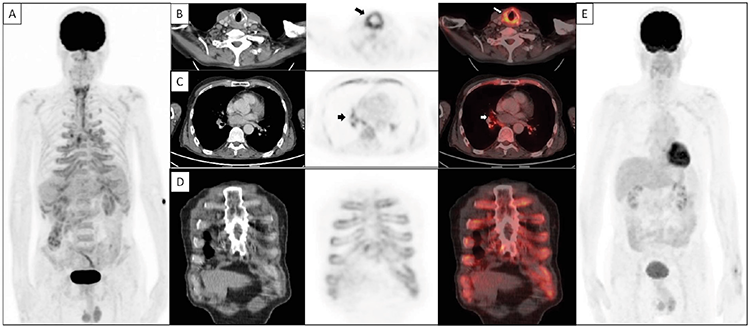
Figure 1
Figure 1. A 58-year-old man with a history of granulomatosis with polyangiitis presented with shortness of breath, hoarseness, myalgia, arthralgia, and weight loss of 10 kg within two months. Laboratory findings were as follows: C-reactive protein (CRP), 144 mg/L, erythrocyte sedimentation rate (ESR): 93, white blood cell counts, 12,000; and hemoglobin level, 10 g/dL. Due to anemia and age, the patient underwent gastroscopy and colonoscopy, which revealed esophagitis and gastritis. Because of suspected malignancy, the patient underwent 18F-fluorodeoxyglucose positron emission tomography/computed tomography (18F-FDG PET/CT) [A: maximum intensity projection, (MIP)], which showed increased FDG uptake in multiple cartilage joints. Transaxial images demonstrated increased uptake on the cricoid cartilage of the larynx [B: CT, PET and fuzed PET/CT images, arrow, maximum standardized uptake value (SUVmax): 6.8] and tracheobronchial cartilages (C: CT, PET and fuzed PET/CT images, arrow, SUVmax: 5.4). Coronal images of the thorax show (D: CT, PET and fuzed/CT images) increased FDG uptake at costochondral junctions (SUVmax: 3.4). Considering these findings, which were chondritis of the nasal cartilage and respiratory tract with a combination of clinical features, the diagnosis was confirmed as relapsing polychondritis (RPC). The patient received treatment with corticosteroids and methotrexate as anti-inflammatory agents. Subsequently, the patient underwent 18F-FDG PET/CT (E: MIP) for response evaluation, which showed complete metabolic response and acute phase reactants within normal range (CRP: 1.58 mg/L, ESR: 8, white blood cell counts: 7,500). RPC is an orphan disease with an estimated incidence rate of 3.5 in 1 million people (1). RPC, which is associated with progressive autoimmune disorder of cartilage, presents with heterogeneous signs and symptoms in compliance with involvement of structures (2). Because of non-specific symptoms in the early stage of the disease, diagnosis has been delayed in most of the cases (2). Indeed, laboratory findings, part of the diagnostic work-up of RPC, were consistent with inflammation but non-specific to RPC (3). Based on the clinical features, various diagnostic criteria were proposed, including chondritis, which mainly involved auricular, nasal, and laryngotracheobronchial diseases, and arthropathy, which was mainly acute, asymmetric polyarthritis, or oligoarthritis (4). In the last decade, the utility of 18F-FDG PET/CT has been proven in not only oncological purposes but also in non-oncological settings, including inflammatory disorders (5,6). The clinical importance of 18F-FDG PET/CT in RPC for early diagnosis, targeted biopsy site, extent of disease, and treatment response evaluation has been shown in limited studies (7,8). This case highlights the importance of recognizing the typical distribution patterns of RPC on 18F-FDG PET/CT for accurate diagnosis. Furthermore, 18F-FDG PET/CT may play a role in evaluating the treatment response in RPC.
View larger Download

Footnotes

Ethics

Informed Consent: Patient consent was obtained.

Authorship Contributions

Surgical and Medical Practices: C.C., E.G.I., D.H.Ş., M.A., S.K., Concept: C.C., E.G.I., D.H.Ş., Design: C.C., E.G.I., D.H.Ş., Data Collection or Processing: C.C., M.A., Analysis or Interpretation: C.C., E.G.I., D.H.Ş., S.K., Literature Search: C.C., D.H.Ş., Writing: C.C., E.G.I., D.H.Ş., M.A., S.K.

Conflict of Interest: No conflicts of interest were declared by the authors.

Financial Disclosure: The authors declare that this study has received no financial support.

References

1

Luthra HS. Relapsing polychondritis. Primer on the rheumatic diseases, Springer 2008;451-454.

2

Longo L, Greco A, Rea A, Lo Vasco VR, De Virgilio A, De Vincentiis M. Relapsing polychondritis: A clinical update. Autoimmun Rev 2016;15:539-543.

3

Kingdon J, Roscamp J, Sangle S, D’Cruz D. Relapsing polychondritis: a clinical review for rheumatologists. Rheumatology (Oxford) 2018;57:1525-1532.

4

Borgia F, Giuffrida R, Guarneri F, Cannavò SP. Relapsing polychondritis: an updated review. Biomedicines 2018;6:84.

5

Zhuang H, Codreanu I. Growing applications of FDG PET-CT imaging in non-oncologic conditions. J Biomed Res 2015;29:189-202.

6

Pijl JP, Nienhuis PH, Kwee TC, Glaudemans AWJM, Slart RHJA, Gormsen LC. Limitations and pitfalls of FDG-PET/CT in infection and inflammation. Semin Nucl Med 2021;51:633-645.

7

Kubota K, Yamashita H, Mimori A. Clinical value of FDG-PET/CT for the evaluation of rheumatic Diseases: rheumatoid arthritis, polymyalgia rheumatica, and relapsing polychondritis. Semin Nucl Med 2017;47:408-424.

8

Kwok SH, Choi F. Relapsing polychondritis: the oto-rhino-tracheobronchial triad on 18 F-FDG PET/CT. Clin Nucl Med 2023;48:699-701.