
Lincoln Sign: A Rare Presentation of Medication-related Osteonecrosis of the Jaw
PDF

Interesting Image

Lincoln Sign: A Rare Presentation of Medication-related Osteonecrosis of the Jaw

Mol Imaging Radionucl Ther 2024;33(2):118-120 DOI: 10.4274/mirt.galenos.2023.37980
,
PDF
Permissions

Abstract

A 52-year-old female patient with metastatic breast cancer receiving denosumab for 7 years presented with marked diffuse tracer uptake in the mandible on Tc-99m-methylene diphosphonate bone scintigraphy, resembling the Lincoln sign. A diagnosis of medication-related osteonecrosis of the jaw (MRONJ) was confirmed, leading to immediate discontinuation of denosumab. Conservative therapy, including limited debridement and oral rinses, was initiated. MRONJ, a potential complication of bone-modifying agents, is more prevalent in advanced malignancy cases. The Lincoln sign has not been previously reported in MRONJ, emphasizing its consideration in cancer patients undergoing bone-modifying agent treatment.

Keywords: Lincoln sign, medication-related osteonecrosis of the jaw, Tc-99m-methylene diphosphonate bone scintigraphy

Ethics

Informed Consent: Informed consent was obtained from the patient.

Authorship Contributions

Surgical and Medical Practices: T.-K.C., J.C., Concept: T.-K.C., Design: T.-K.C., Data Collection or Processing: T.-K.C., Analysis or Interpretation: T.-K.C., Literature Search: T.-K.C., Writing: T.-K.C.

Conflict of Interest: All authors have disclosed no conflicts of interest.

Financial Disclosure: The authors declared that this study received no financial support.
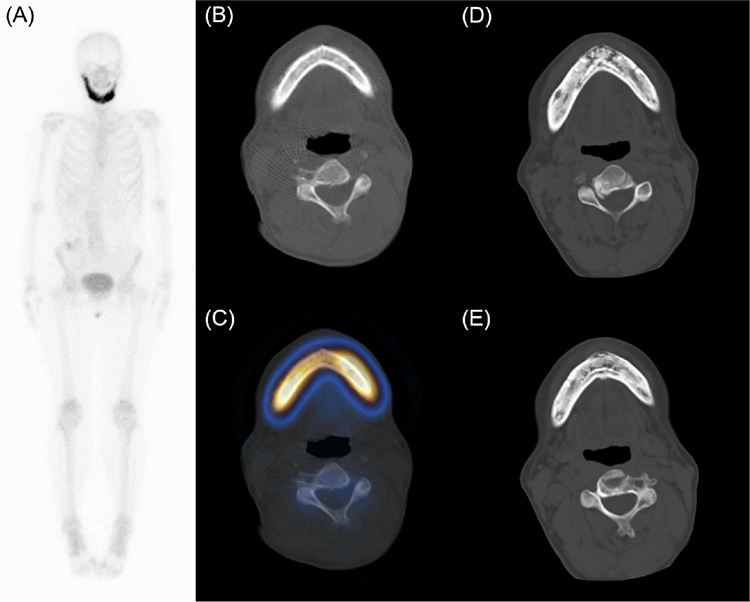
Figure 1
Figure 1. A 52-year-old woman, who was known to have stage IV breast cancer with metastasis to bone and liver and was administered a subcutaneous injection of denosumab for 7 years, presented with gradual onset of non-mobile submental hard mass and oral ulcer. There was no history of radiation therapy or metastatic disease of the jaws. The patient was referred for Tc-99m-methylene diphosphonate (MDP) bone scintigraphy to rule out progression of bone metastasis. Whole-body Tc-99m-MDP bone scintigraphy showed marked diffuse tracer uptake in the mandible, resembling the Lincoln sign (A). Single photon emission computed tomography/computed tomography (CT) demonstrated diffuse sclerosis with periosteal reaction in the mandible (B, C). No other abnormal bony tracer uptake focus was observed. Physical examination by a dental surgeon revealed bilateral orocutaneous fistulas at the lower border of the mandible with exposed bone. A clinical diagnosis of stage III medication-related osteonecrosis of the jaw (MRONJ) was made. Denosumab was discontinued immediately. The patient opted for conservative therapy with limited debridement and oral rinses with chlorhexidine. A subsequent CT study performed three years later showed diffuse sclerotic appearance of the mandible with multiple irregular lucency in the mandibular body and cortical bone loss (D, E), consistent with MRONJ. MRONJ is a potentially serious complication of bone modifying agent (BMA), which is more common in patients with advanced malignancy than in patients with osteoporosis (1). The cumulative incidence rates of MRONJ increase with longer duration of BMA exposure, with an incidence of 0.7%-1.4% during the first year of therapy and increasing to 2%-3.4% with continued treatment beyond one year (2). Other risk factors of MRONJ include previous oral surgery, periodontal disease, use of dentures, smoking, angiogenesis inhibitors, and diabetes (3). MRONJ can be classified into stages I-III, depending on the presence of exposed and necrotic bones, fistulas that probe to bone, symptoms, evidence of infection, and extent of lesions (3). Symptomatic treatment with antibacterial mouth rinse and analgesics can be administered to patients with early-stage disease, whereas surgical debridement or resection may be required for those with advanced-stage disease. The Lincoln sign on bone scintigraphy is characteristic of monostotic Paget’s disease of the mandible and is less commonly observed in primary mandibular tumors (4), contiguous spread of oral malignancies (4), or distant metastases to the mandible (5). The Lincoln sign has not been reported in MRONJ previously, and this condition should be considered in cancer patients treated with BMA.
View larger Download

Footnotes

Ethics

Informed Consent: Informed consent was obtained from the patient.

Authorship Contributions

Surgical and Medical Practices: T.-K.C., J.C., Concept: T.-K.C., Design: T.-K.C., Data Collection or Processing: T.-K.C., Analysis or Interpretation: T.-K.C., Literature Search: T.-K.C., Writing: T.-K.C.

Conflict of Interest: All authors have disclosed no conflicts of interest.

Financial Disclosure: The authors declared that this study received no financial support.

References

1

Goodwin JS, Zhou J, Kuo YF, Baillargeon J. Risk of Jaw Osteonecrosis After Intravenous Bisphosphonates in Cancer Patients and Patients Without Cancer. Mayo Clin Proc 2017;92:106-113.

2

Stopeck AT, Fizazi K, Body JJ, Brown JE, Carducci M, Diel I, Fujiwara Y, Martín M, Paterson A, Tonkin K, Shore N, Sieber P, Kueppers F, Karsh L, Yardley D, Wang H, Maniar T, Arellano J, Braun A. Safety of long-term denosumab therapy: results from the open label extension phase of two phase 3 studies in patients with metastatic breast and prostate cancer. Support Care Cancer 2016;24:447-455.

3

Yarom N, Shapiro CL, Peterson DE, Van Poznak CH, Bohlke K, Ruggiero SL, Migliorati CA, Khan A, Morrison A, Anderson H, Murphy BA, Alston-Johnson D, Mendes RA, Beadle BM, Jensen SB, Saunders DP. Medication-Related Osteonecrosis of the Jaw: MASCC/ISOO/ASCO Clinical Practice Guideline. J Clin Oncol 2019;37:2270-2290.

4

Bal CS, Sahoo MK, Damle N. Lincoln’s sign: where should we expect on 99mTc-MDP bone scintigraphy? Clin Nucl Med 2013;38:e390-e391.

5

Kulkarni M, Soni A, Shetkar S, Amer M, Mulavekar A, Joshi P. Coexistent Superscan and Lincoln Sign on Bone Scintigraphy. Clin Nucl Med 2017;42:630-632.