
Abstract
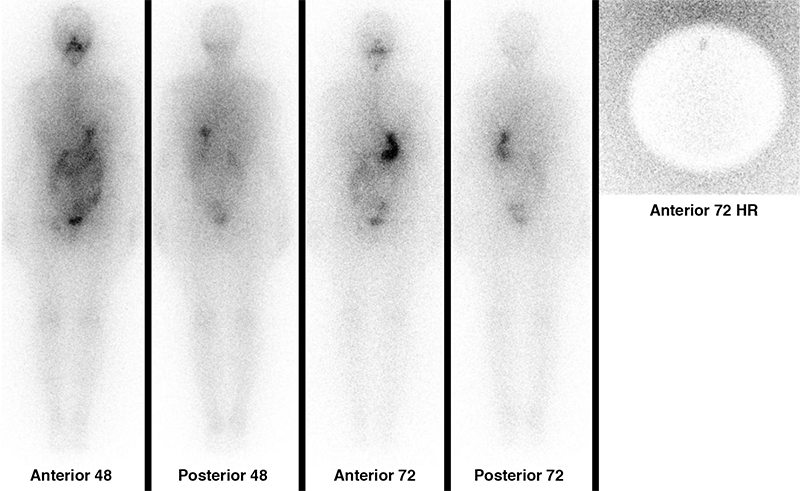
We present a rare case with inguinal iodine-131 (I-131) uptake on whole body scan. The patient was suffering from a painful right inguinal mass during menstrual period, which was later sonographically and histopathologically confirmed to be an inguinal focus of endometriosis. Endometriosis is a previously reported site of radioiodine uptake and detection of radioiodine uptake in the inguinal region has also been described. Nevertheless, to the best of our knowledge, this is the first case report of I-131 uptake in an inguinal endometriosis focus. History and physical examination of the patient are both very important in identifying the etiology of the ectopic uptake sites on I-131 whole body scan, and inguinal endometriosis should be kept in mind while reporting inguinal radioiodine uptake on I-131 whole body scan.
Keywords: Endometriosis, whole body imaging, iodine-131
Endometriosis is the existence of endometrium, the layer surrounding the uterine cavity, anywhere in the body other than the uterus. It is mostly located in the intrapelvic region (1). Inguinal (non-cutaneous) endometriosis is a rare presentation of endometriosis, occurring in only 0.6% of women (1,2). Inguinal endometriosis was first reported by Allen in 1896 (3,4,5). Patients with inguinal endometriosis complain of inguinal mass and pain, in particular, acute pain during menstrual cycles (2,6). The mechanism of iodine uptake in endometriosis is not yet clear, and iodine uptake in inguinal endometriosis has not been previously described in the literature. In our case, the scanning was performed during the patient’s menstrual cycle. An increase in blood flow to the inguinal endometriosis or presence of inflammation in this area might be the reasons for increased radioiodine uptake. Hyperemia, vasodilation, local edema, and increased capillary permeability may cause increased radioiodine uptake in inflamed areas (7,8). In our case, there were multiple reactive lymph nodes around the inguinal mass. Both increased blood flow and reactive lymph nodes could have led to an increased activity. In conclusion, although it is a well-established technique, one may still confront with unexpected findings on I-131 whole body scan. While reporting radioiodine uptake in the inguinal region, endometriosis should be kept in mind as a rare etiology and the patient should be further evaluated accordingly.
Focal I-131 accumulation on the neck, located in the midline, is detected along with radioiodine uptake in the right inguinal region on I-131 whole body images.
Footnotes
Ethics
Informed Consent: Consent form was filled out by all participants.
Peer-review: Externally peer-reviewed.
Authorship Contributions
Surgical and Medical Practices: D.Ç., M.A., M.A., E.Ç., Concept: D.Ç., Design: D.Ç., M.A., Data Collection or Processing: D.Ç., M.A., Analysis or Interpretation: D.Ç., M.A., Literature Search: D.Ç., Writing: D.Ç.
Conflict of Interest: No conflict of interest was declared by the authors.
Financial Disclosure: The authors declared that this study received no financial support.