Unilateral Muscle Artifacts due to Non-compliance During Uptake Phase of 18F-FDG PET/CT in an Oncologic Patient
PDF

Interesting Images

Unilateral Muscle Artifacts due to Non-compliance During Uptake Phase of 18F-FDG PET/CT in an Oncologic Patient

Mol Imaging Radionucl Ther 2018;27(1):32-36 DOI: 10.4274/mirt.02419
,
PDF
Permissions

Abstract

A 49-year-old male patient with a prior history of poor compliance with medical appointments was referred for an 18F-fluoro-2-deoxy-D-glucose (18F-FDG) positron emission tomography/computed tomography (PET/CT) for the staging of a rectal squamous cell carcinoma. The PET/CT showed unilateral diffuse skeletal muscle 18F-FDG uptake as well as bilateral salivary gland uptake artifacts, suggestive of non-compliance with patient preparation instructions. The PET/CT nurse noted that during the 18F-FDG uptake phase, the patient appeared intoxicated, and she found two beer cans hidden in the waste disposal beside his chair just prior to imaging. The patient only admitted to eating a cookie approximately 30 minutes after the injection of 18F-FDG PET/CT and denied consuming alcohol during the uptake phase. We present the imaging findings of non-compliance with patient instructions during the uptake phase of 18F-FDG.

Keywords: Non-compliance, artifact, pitfall, muscle, musculoskeletal, 18F-FDG, PET
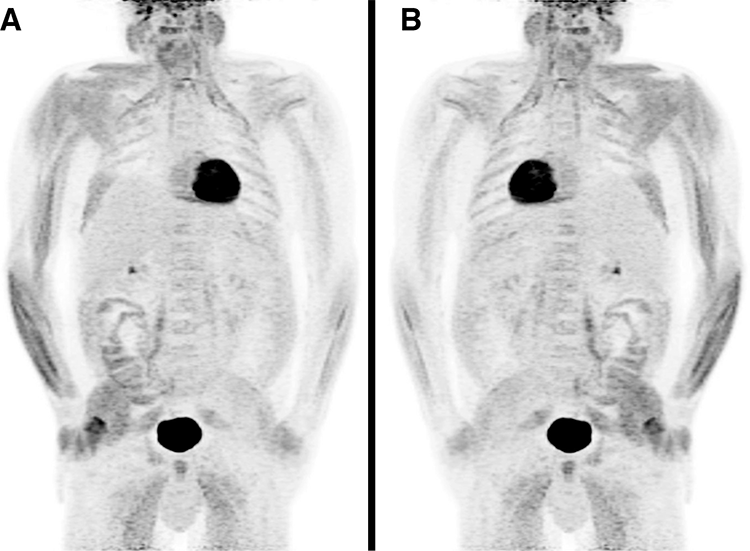
Figure 1
Figure 1. A 49-year-old male patient had 18F-fluoro-2-deoxy-D-glucose (18F-FDG) positron emission tomography/computed tomography (PET/CT) (Biograph-mCT, Siemens, Germany) to stage a rectal squamous cell carcinoma. He was injected with 352 MBq of 18F-FDG and his blood glucose was 6.8 mmol/L just prior to injection. During the 60-minute uptake phase prior to imaging, the nurse observed the patient: he was sitting and leaning on one side, appeared intoxicated and his breath smelled of alcohol. He was constantly moving in his seat. Two beer cans were found in the waste disposal next to his chair just prior to imaging. On questioning, he denied drinking alcohol and only admitted to eating a cookie at approximately 30 minutes after 18F-FDG injection. PET/CT maximum intensity projection images with (A) anterior and (B) posterior views revealed diffuse intense unilateral muscle 18F-FDG uptake artifacts involving the right shoulder, arm, hand, right chest wall and right gluteus muscles.
View larger Download
Figure 2
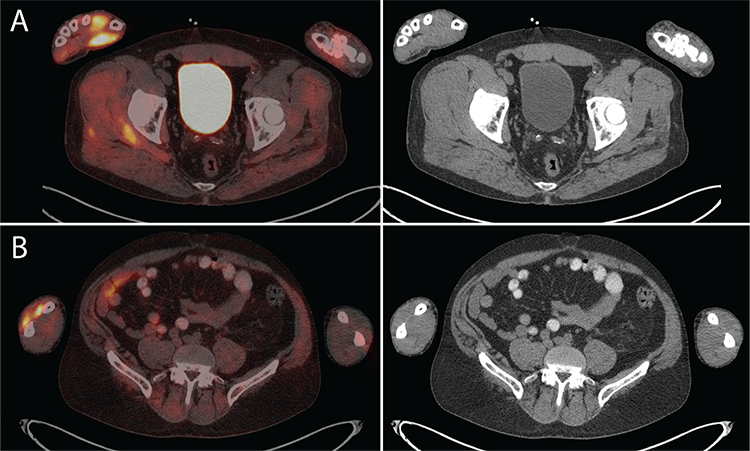
Figure 2. (A) Intense 18F-FDG uptake in the right thenar eminence with maximum standard uptake value (SUVmax) 8.8 was the most intensely 18F-FDG avid abnormality in the entire PET/CT study, and was most likely the result of the patient holding beer cans and drinking beer. (B) Right dorsal extensor forearm muscles also showed intense 18F-FDG uptake with SUVmax 6.7.
View larger Download
Figure 3
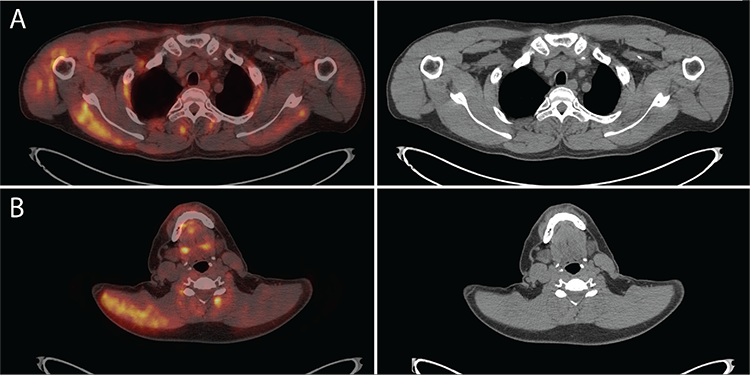
Figure 3. Right biceps muscles showed increased 18F-FDG uptake with SUVmax 5.0, (A) right shoulder muscles had SUVmax 4.0, (B) right trapezius muscle had SUVmax 4.1 and right serratus anterior muscle had SUVmax 3.8.
View larger Download
Figure 4
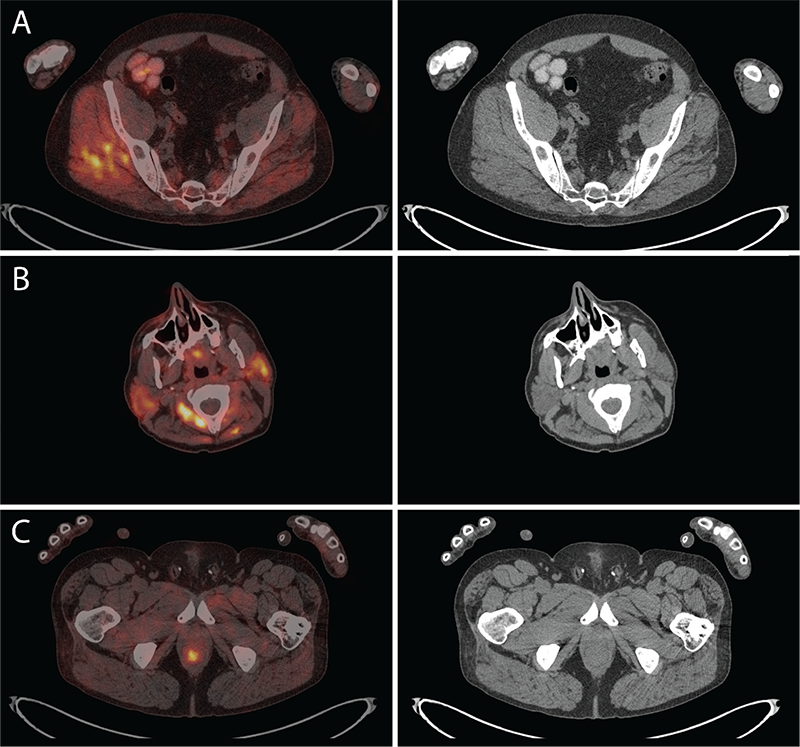
Figure 4. (A) Right gluteal muscles showed increased 18F-FDG uptake with SUVmax 5.3, and (B) both parotid glands showed increased 18F-FDG uptake with SUVmax 4.7 in the right and SUVmax 4.8 in the left, most likely due to alcohol/food consumption. (C) The rectal primary lesion had intense 18F-FDG uptake with SUVmax 5.2 and there was no evidence of distant metastases. The 18F-FDG physiologic uptake artifacts from physical activity and movements of the right hand, arm, shoulder and gluteus maximus (as well as drinking and eating), with normal corresponding CT findings, did not interfere with cancer staging. It is important that a patient is relaxed at time of 18F-FDG injection and has avoided vigorous exercise in the hours leading up to the PET/CT. Most authors recommend avoiding physical exercise 24 hours before 18F-FDG administration (1,2,3,4), although vigorous exercise up to 4 days before imaging has been reported to cause muscle 18F-FDG uptake artifacts (5). Diffusely increased 18F-FDG uptake in muscles, as a PET/CT artifact, has been described in the following situations: insulin administration (6), voluntary physical activity such as chewing gum, exercise or sexual activity (4,5,7), involuntary physical activity such as labored breathing or muscle spasms (8), post surgical changes (9,10), post radiation inflammation (11), dermatomyositis (12), infection (10,13,14), or post injection (15). Unilateral intense muscle 18F-FDG uptake is rare and has been described in a few cases such as hemiparesis from stroke (16), in patients with multiple sclerosis (17), due to tracer injections (15) or more commonly in certain head and neck muscles (18). Non-compliance with patient instructions during the uptake phase of 18F-FDG can cause significant artifacts and recent examples in the literature include smartphone use (19), reading a small book and even tapping the foot (20).
View larger Download

Footnotes

Ethics

Informed Consent: All subjects in the study gave written informed consent or the institutional review board waived the need to obtain informed consent.

Peer-review: External and internal peer-reviewed.

Authorship Contributions

Surgical and Medical Practices: W.M., E.W.H., Concept: W.M., Design: W.M., Data Collection or Processing: W.M., E.W.H., Analysis or Interpretation: W.M., E.W.H., Literature Search: W.M., E.W.H., Writing: W.M.

Conflict of Interest: No conflict of interest was declared by the authors.

Financial Disclosure: The authors declared that this study received no financial support.